
Anuncio

Edgar Allan Poe: Berenice
Anuncio Dicebant mihi sodales, si sepulchrum amicae visitarem,curas meas aliquantulum fore levatas.—Ebn Zaiat Anuncio MISERY is manifold. The wretchedness of earth is multiform. Overreaching the wide horizon as the rainbow, its hues are as various as the hues of that arch,—as distinct too, yet as intimately blended. Overreaching the wide horizon as the rainbow! How is … Read more

Edgar Allan Poe: Eleonora
Eleonora is a gothic tale by Edgar Allan Poe, published in 1841. It tells the story of a young man who lives in a paradisiacal valley with his cousin Eleonora. In this haven of beauty and isolation, the two share an existence of pure love and simple harmony, surrounded by dreamy landscapes and the silent flow of a magical river. However, a shadow threatens to break their idyllic life, forcing them to confront the fragility of happiness and the strength of the ties that bind them together.

Edgar Allan Poe: Ligeia
“Ligeia” is a Gothic horror tale by Edgar Allan Poe, published on September 18, 1838, in the magazine American Museum. It recounts the intense relationship between the narrator and Ligeia, a woman of extraordinary beauty and intelligence, whom he met in a ruined city near the Rhine. In their union, they share love, passion, and a profound intellectual respect. Ligeia’s death plunges the narrator into a spiral of decay from which not even his marriage to the beautiful Rowena can rescue him. The memory of—and obsession with—Ligeia haunts the narrator, tormenting him even though she rests in her grave.
Edgar Allan Poe: Morella
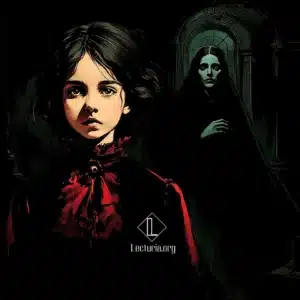
“Morella” is a short story by Edgar Allan Poe, published in April 1835 in the Southern Literary Messenger. A man marries Morella, a woman of great erudition and a marked inclination toward metaphysics and mystical knowledge. Although he initially feels deeply attached to her, over time he experiences a growing detachment and an inexplicable aversion toward his wife, a feeling that intensifies as she languishes and her presence becomes increasingly disturbing.

Edgar Allan Poe: MS. Found in a Bottle
MS. Found in a Bottle is a short story by Edgar Allan Poe, published on 19 October 1833 in the Baltimore Saturday Visiter. It tells the story of an anonymous man who, dissatisfied with his life and searching for escape, embarks on a ship sailing from Batavia, Java, to an uncertain destination. Although the voyage begins smoothly, an unearthly calm soon overtakes the sea, foreshadowing a colossal storm that abruptly breaks loose, plunging the ship into chaos and panic.
Edgar Allan Poe: Shadow—A Parable
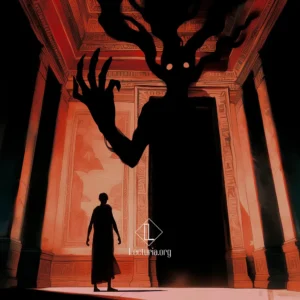
“Shadow—A Parable” is a short story by American writer Edgar Allan Poe, published in September 1835 in The Southern Literary Messenger and later included in Tales of the Grotesque and Arabesque (1840). Set in the fictional city of Ptoleméis during a devastating plague, the story begins with a group of seven men locked in a gloomy room, drinking wine beside the recent corpse of a friend. As they try to ignore the horror outside, an inexplicable shadow emerges from the draperies of the room, interrupting their forced revelry with a presence that seems to speak from a place beyond time.

Edgar Allan Poe: Silence—A Fable
In “Silence” (Silence—A Fable), a short story by Edgar Allan Poe published in 1838 in Baltimore Book, a demon tells a story about a desolate region in Libya near the Zaire River. A disturbing landscape marks this land: a sickly river, gigantic water lilies, and a dark and turbulent jungle, all without calm or silence. One night, under a rain that turns to blood, the demon observes a majestic man on a rock. This man, lonely and melancholic, contemplates the desolate landscape. The demon invokes the elements to torment him, but nothing seems to move this man, who is tired of people and eager to be alone.

Edgar Allan Poe: The black cat
“The Black Cat” is a psychological horror short story by Edgar Allan Poe, published on August 19, 1843, in The Saturday Evening Post. Told in the first person, it recounts the story of a man who, since childhood, has felt a deep affection for animals—especially for his cat, Pluto. However, the abuse of alcohol gradually transforms his character, leading him to violence and depravity. As his behavior deteriorates, his relationship with the animal grows dark and obsessive, while the narrator begins to reveal the deepest and most terrifying recesses of his tormented mind.

Edgar Allan Poe: The Cask of Amontillado
The Cask of Amontillado is a short story by Edgar Allan Poe, published in November 1846 in Godey’s Lady’s Book magazine. Set in Italy during carnival time, it tells the story of a man who plots a subtle and calculated revenge against Fortunato, a proud wine connoisseur he considers guilty of multiple offenses. Taking advantage of his passion for amontillado sherry, he lures him into the catacombs of his house on the pretext of verifying the authenticity of a barrel. Fortunato accepts, unaware of the sinister purpose behind the invitation.

Edgar Allan Poe: The Facts in the Case of M. Valdemar
“The Facts in the Case of M. Valdemar,” a short story by Edgar Allan Poe, published in 1845, explores the boundaries of life and death through hypnosis. The story’s protagonist, a hypnotism expert, decides to experiment with Mr. Valdemar, who is on his deathbed. Since Valdemar is seriously ill and has no relatives in America who could object, he voluntarily agrees to the test. The plot unfolds in Valdemar’s room, where the protagonist and other witnesses observe the effects of the hypnotism applied just as Valdemar is about to pass away. Their discoveries are surprising.

Edgar Allan Poe: The Fall of the House of Usher
Edgar Allan Poe’s “The Fall of the House of Usher” tells the story of a man who visits the home of his childhood friend, Roderick Usher, who has asked him for help due to his fragile physical and mental health. Upon arrival, he finds an old and desolate mansion, which seems to have a sinister influence on its inhabitants. As the visit continues, the protagonist witnesses not only the mental deterioration of his friend but also the decline of his sister, Madeline, who is suffering from a strange disease that consumes her life. The oppressive atmosphere and supernatural events envelop the protagonist in a spiral of terror and despair.

Edgar Allan Poe: The Man of the Crowd
“The Man of the Crowd” is a short story by Edgar Allan Poe, published in December 1840 in Burton’s Gentleman’s Magazine and Atkinson’s Casket. A man observes from the window of a London café the ceaseless flow of people along a bustling avenue. For hours he watches and classifies the passersby according to their appearance and behavior: merchants, clerks, gamblers, beggars, prostitutes. As night falls, his attention is captured by an old man with an extraordinarily enigmatic expression. Driven by an irresistible curiosity, he leaves the café to follow the mysterious figure through the nocturnal streets of London.
Edgar Allan Poe: The Masque of the Red Death
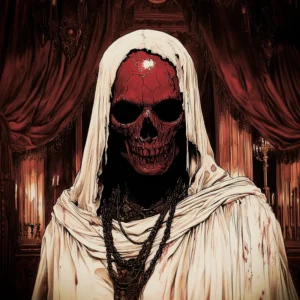
The Masque of the Red Death, a short story by Edgar Allan Poe published in 1842, immerses the reader in an allegory about the inevitability of death. Set in an indeterminate time plagued by a devastating plague known as the Red Death, the kingdom’s prince decides to isolate himself in his fortified abbey along with other nobles, seeking to escape the disease. He organizes a luxurious masked ball in his refuge, ignoring the suffering ravaging the outside world. However, some guests do show up, even if they are not called.

Edgar Allan Poe: The Oval Portrait. Full Story, Summary and Analysis
The Oval Portrait, a short story by Edgar Allan Poe, tells the story of a badly injured man who takes refuge in an abandoned castle with his servant. Intrigued by the numerous paintings in the castle, he discovers an oval portrait of a young woman that appears almost lifelike. Reading a book on the history of the paintings, he learns that the painter of the portrait was obsessed with capturing the essence of his young wife, devoting himself wholeheartedly to the task. The painting and the artist’s story reveal a deep connection between art and life, unveiling the painter’s intense dedication and the consequences of his obsession.

Edgar Allan Poe: The Pit and the Pendulum
“The Pit and the Pendulum,” a short story by Edgar Allan Poe published in 1842, is a chilling tale that follows the anguish of a prisoner during the Spanish Inquisition. After being sentenced, the protagonist awakens in a dark and sinister cell, unaware of the fate that awaits him. In this claustrophobic place, he discovers that the punishment he has been assigned was conceived by a twisted and sadistic mind. Faced with various mechanisms of torture, the prisoner is subjected to extreme physical and psychological torment, where terror and despair become his only companions as he struggles to survive in this earthly hell.
Edgar Allan Poe: The Premature Burial
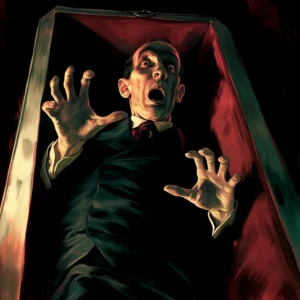
“The Premature Burial” is a short story by Edgar Allan Poe, published on July 31, 1844, in the Dollar Newspaper. Written in a style that lies midway between fiction and journalistic reportage, it tells the story of a man obsessed with the possibility of being buried alive. Drawing on documented cases of premature interments in various places, it argues that such events occur with disturbing frequency. He himself, prone to attacks of catalepsy and overwhelmed by fear, takes a series of precautions to avoid becoming a victim of that horrific fate.

Edgar Allan Poe: The Purloined Letter
“The Purloined Letter” is a short story by Edgar Allan Poe, published in September 1844 in The Gift for 1845. In Paris, the police prefect visits detective C. Auguste Dupin to consult him on a case that has him baffled: a letter of enormous political importance has been stolen right under its owner’s nose by Minister D…, who is using it to blackmail her. Although the police have thoroughly searched the alleged thief’s mansion, the letter remains missing. Faced with the failure of conventional methods, the prefect turns to Dupin’s ingenuity, who will use his unique analytical skills to solve the mystery.

Edgar Allan Poe: The Sphinx
Anuncio DURING the dread reign of the Cholera in New-York, I had accepted the invitation of a relative to spend a fort-night with him in the retirement of his cottage ornée on the banks of the Hudson. We had here around us all the ordinary means of summer amusement; and what with rambling in the woods, sketching, boating, … Read more

Edgar Allan Poe: The Tell-Tale Heart
Anuncio “The Tell-Tale Heart” is a story by Edgar Allan Poe, published in 1843, that delves into the dark recesses of the human mind. The tale follows a protagonist who insists on his sanity as he narrates the events surrounding his cohabitation with an older man. The story centers on the narrator’s obsession with a … Read more

Edgar Allan Poe: William Wilson
William Wilson is a Gothic tale by Edgar Allan Poe, published in Burton’s Gentleman’s Magazine in October 1839. The story follows a man who adopts the pseudonym’ William Wilson’ to recount his life, marked from a young age by an impulsive character, lewd behavior, and a strong desire to dominate others. During his time at an English school, he faces an unexpected challenge: a classmate with the same name who imitates him and matches him in skills in a disturbing way. As the years pass, the presence of this double becomes a constant and threatening shadow, challenging his will and questioning his identity.
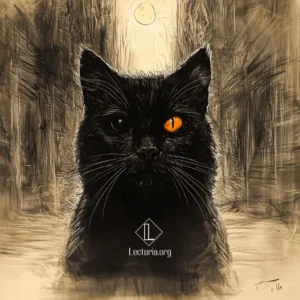
Edgar Allan Poe: The Black Cat. Summary and analysis
In Edgar Allan Poe’s “The Black Cat,” a man condemned to death recounts his progressive moral decline. An animal lover in his youth, his character is corrupted by alcoholism, becoming violent and cruel. After mutilating and finally hanging his black cat, Pluto, his house mysteriously burns down. Sometime later, he finds another black cat, almost identical to the previous one, with a peculiar white spot that gradually takes the shape of a gallows, increasing his paranoia and fear. The obsessive presence of the new animal fuels his mental instability. During a fit of rage, he tries to kill the cat, but his wife stops him, and he brutally murders her. He decides to hide the body by walling it up in the basement. After several days, the police inspect the house without finding any evidence of the crime, but when the protagonist, in a gesture of arrogance, hits the wall where the body lies, a bloodcurdling scream is heard from inside. When they knock down the wall, the officers discover the corpse of his wife with the cat still alive on top of her, revealing the murder and sealing his fate.
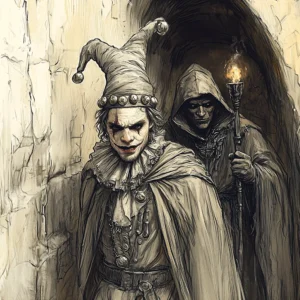
Edgar Allan Poe: The Cask of Amontillado. Summary and analysis
Plot summary: Montresor, a man driven by a desire for revenge, carefully plans the murder of Fortunato, whom he considers responsible for multiple grievances. Taking advantage of his victim’s pride in his knowledge of wines, he deceives him during the carnival by making him believe he possesses a rare cask of amontillado. Using this as an excuse, he leads him to his family’s catacombs, located under his palace. Once there, after a series of deceptions disguised as courtesy, he locks him in a hidden niche and buries him alive, building a brick wall. Fortunato, who at first shows disbelief, ends up understanding his fate, while Montresor carries out his crime with serenity and without remorse. Decades later, he confesses to the murder with cold satisfaction and reveals that he was never discovered.
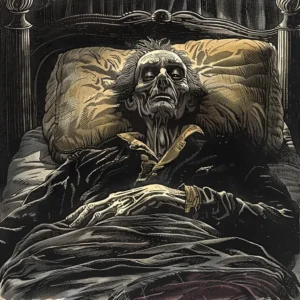
Edgar Allan Poe: The Facts in the Case of M. Valdemar. Summary and analysis
“The Facts in the Case of M. Valdemar” by Edgar Allan Poe narrates a disturbing scientific experiment. A hypnotist, fascinated by the boundaries between life and death, decides to try to hypnotize a person at the moment of their death. To do this, he recruits Ernest Valdemar, a terminally ill man. With the help of doctors and assistants, the narrator undertakes this audacious experiment, exploring unknown territories of the human consciousness. As the process advances, the participants face inexplicable phenomena that challenge their understanding of reality and death. The story combines elements of psychological horror with a pseudo-scientific approach, creating an atmosphere of growing tension and mystery that keeps the reader in suspense until its surprising conclusion.
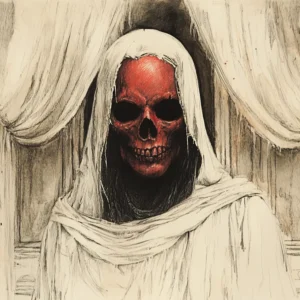
Edgar Allan Poe: The Masque of the Red Death. Summary and analysis
The Masque of the Red Death, written by Edgar Allan Poe and published in 1842, is a story that combines horror and fantasy to explore the inevitability of death. In a kingdom devastated by a lethal plague, Prince Prospero takes refuge with a group of nobles in his fortified abbey. He organizes a luxurious masked ball to escape the horror outside. Amid the opulent festivities, a mysterious figure appears among the guests, sowing fear and uncertainty.
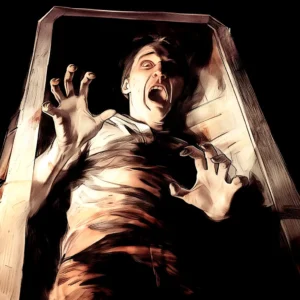
Edgar Allan Poe: The Premature Burial. Summary and Analysis
“The Premature Burial”, written by Edgar Allan Poe and published in 1844, explores one of humanity’s deepest fears: the fear of being buried alive. Through a narrator obsessed with this fate, the story immerses us in an atmosphere of anguish and paranoia and reflects on the thin line that separates life from death. The story combines chilling accounts of confirmed cases with the experiences of the protagonist, who lives in constant panic due to an illness.

Edgar Allan Poe: The Tell-Tale Heart. Summary and analysis
Anuncio “The Tell-Tale Heart” is a story by Edgar Allan Poe, published in 1843, that delves into the dark recesses of the human mind. The tale, narrated in the first person, follows a protagonist who insists on his sanity as he tells the events surrounding his cohabitation with an older man. The story centers on … Read more
Anuncio