Anuncio

Nathaniel Hawthorne: Dr. Heidegger’s Experiment
“Dr. Heidegger’s Experiment” is a short story by Nathaniel Hawthorne, first published in Knickerbocker Magazine in January 1837 and later included in Twice-Told Tales (1837). It tells of the eccentric Dr. Heidegger, who invites four elderly friends—once distinguished by wealth, beauty, power, and pleasure but now broken by time and misfortune—into his mysterious study. Amid dusty tomes, strange relics, and the portrait of his lost fiancée, the doctor proposes a peculiar experiment involving a liquid said to flow from the legendary Fountain of Youth.
Nathaniel Hawthorne: Earth’s Holocaust
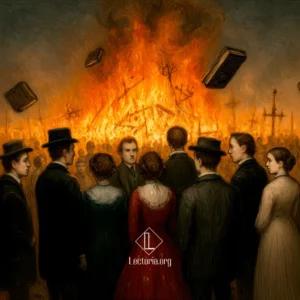
“Earth’s Holocaust” is an allegorical short story by Nathaniel Hawthorne, published in May 1844 in Graham’s Magazine and collected in Mosses from an Old Manse (1846). The story begins with the organization of a huge bonfire, where crowds from all over the world gather to destroy ancient symbols of power, prestige, and tradition. In a reformist fervor seeking the moral regeneration of humanity, material objects, and entire institutions are thrown into the fire: noble titles, royal emblems, weapons, beverages, books, and even religious symbols. However, something essential remains intact, hidden from the power of the flames.

Nathaniel Hawthorne: Feathertop: A Moralized Legend
“Feathertop: A Moralized Legend” is a short story by Nathaniel Hawthorne, published in February 1852 in The International Magazine. Mother Rigby, a powerful New England witch, makes a scarecrow for her cornfield using sticks, straw, old clothes, and a pumpkin for a head. Fascinated by the result of her handiwork, the witch decides to use magic to breathe life into it. Transformed into a handsome and refined gentleman, the figure—christened Feathertop—is sent by its creator into the vain world of human beings to try its luck.

Nathaniel Hawthorne: Rappaccini’s Daughter
Rappaccini’s Daughter, a gothic tale by Nathaniel Hawthorne, tells the story of Giovanni Guasconti, a young student who arrives in Padua and settles in a modest room overlooking a mysterious garden. This garden belongs to Dr. Rapaccini, a scientist renowned for experimenting with poisonous plants. Giovanni soon becomes fascinated by Beatrice, the doctor’s beautiful daughter, who seems to live in symbiosis with the garden’s strange plants. As Giovanni approaches Beatrice, he discovers that her beauty hides a deadly danger.
Nathaniel Hawthorne: Roger Malvin’s Burial
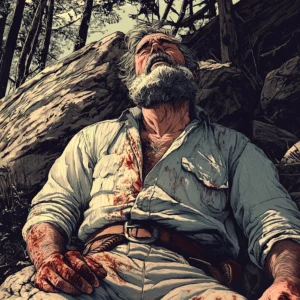
“Roger Malvin’s Burial” is a short story by Nathaniel Hawthorne, first published in 1832 in The Token. Reuben Bourne and Roger Malvin are two men who, after escaping from a bloody battle between settlers and Native Americans, are left seriously wounded. Lost in the vastness of the forest and with no help in sight, Malvin—aware that his condition is terminal—begs Reuben to abandon him in order to save himself. Though he resists, Reuben realizes that setting out in search of aid is the only hope of saving Malvin.
Nathaniel Hawthorne: The Wives of the Dead
Anuncio The following story, the simple and domestic incidents of which may be deemed scarcely worth relating, after such a lapse of time, awakened some degree of interest, a hundred years ago, in a principal seaport of the Bay Province. The rainy twilight of an autumn day, — a parlor on the second floor of … Read more
Nathaniel Hawthorne: Wakefield
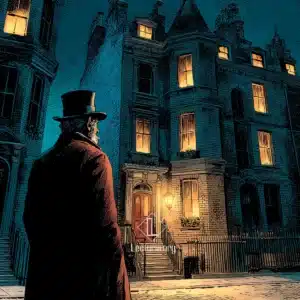
“Wakefield” is a short story by the American writer Nathaniel Hawthorne, published in The New-England Magazine in May 1835. Under the pretext of taking a brief trip, a man abandons his home and his wife and secretly installs himself in a room on the street next to his own. For no apparent reason, he observes from a distance the life he has left behind, becoming an invisible spectator of his own absence. What was meant to be a getaway of only a few days gradually stretches on, as Wakefield sinks into anonymity and indefinitely postpones his return.

Nathaniel Hawthorne: Young Goodman Brown
Young Goodman Brown is a horror story written by Nathaniel Hawthorne and published in The New England Magazine in April 1835. The story follows Goodman Brown, a young man from Salem who one night takes leave of his wife to keep an enigmatic and urgent appointment. Shortly into the journey, he encounters a mysterious man who reveals himself to be Satan, and together, they go deep into the woods, where he witnesses a disturbing ceremony. That night, Brown will be confronted with disturbing revelations that will shake his faith and vision of everything around him, marking a before and after in his life.
Nathaniel Hawthorne: Earth’s Holocaust. Summary and analysis
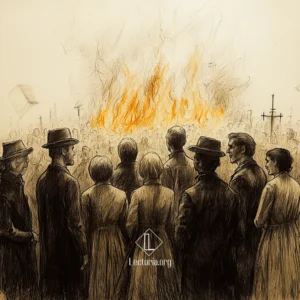
In Earth’s Holocaust, Nathaniel Hawthorne presents an allegory in which humanity, determined to free itself from all the evils of the past, organizes a gigantic bonfire in a meadow to burn symbols of power, customs, institutions, and cultural objects. Noble titles, crowns, weapons, alcoholic beverages, books, money, instruments of execution, and even religious objects are destroyed in a radical attempt at social purification. Throughout the event, an anonymous narrator observes with growing unease how, in its eagerness for renewal, humanity also seems to be losing its spiritual and cultural roots. In the end, after even burning the Bible, a sinister figure reveals that it has all been in vain, for the true source of evil—the human heart—remains intact. The story concludes with the reflection that until the inner nature of human beings is transformed, all attempts at external reform are doomed to repeat past mistakes.
Nathaniel Hawthorne: Young Goodman Brown. Summary and analysis
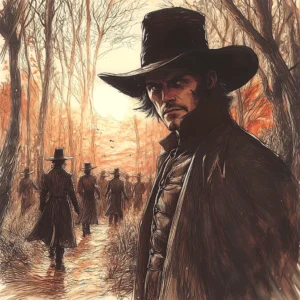
Plot summary: One afternoon, Goodman Brown says goodbye to his wife, Faith, and goes into a forest near Salem to meet a mysterious man carrying a snake-shaped staff who seems to know dark secrets about the young man’s ancestors and neighbors. As they go deeper into the forest, Brown discovers with growing horror that respected people in his community — such as his former catechism teacher, the deacon, and even the minister of the church — are participating in a coven. In desperation, he thinks he hears his wife’s voice among the attendees and apparently sees her being initiated into a satanic ritual. At the climax, just as the Devil is about to mark them both, Brown cries out to heaven and wakes up alone in the middle of the forest. On returning to the village, he cannot discern whether what he experienced was real or a dream, but the doubt torments him. From then on, he lives consumed by mistrust, convinced that evil dwells even in the most virtuous. He grows old, bitter, and lonely, never recovering his faith or his peace, and dies cut off from the world beneath a tombstone bearing no words of hope.
Anuncio