
Anuncio
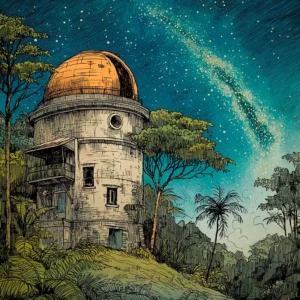
H. G. Wells: In the Avu Observatory
“In the Avu Observatory” is a short story by H. G. Wells, published on August 9, 1894, in the Pall Mall Budget magazine. Set in a remote astronomical station in the jungles of Borneo, it narrates the disturbing experience of Woodhouse, a young assistant who is left alone in the observatory while he makes stellar observations. The tranquility of the tropical night, with its distant sounds and the vast darkness of the forest, is transformed into an atmosphere charged with tension and uncertainty when an unknown presence bursts into the enclosure.

H. G. Wells: The Country of the Blind
“The Country of the Blind” is a short story by H. G. Wells, published in April 1904 in The Strand Magazine. It tells the story of a mountain guide who, during an expedition in the Andes, suffers an accident that leads him to a remote valley, isolated from the outside world. There, he discovers a population that has lived for centuries without the sense of sight and has developed its life, customs, and beliefs without any reference to the visible world. Convinced that his ability to see will give him an advantage, he tries to impose himself as a leader, unaware that he will face challenges for which he may not be prepared.

H. G. Wells: The Crystal Egg
“The Crystal Egg” is a science fiction story by H. G. Wells published in The New Review in May 1897. It tells the story of Mr. Cave, an antique dealer who owns a small, dilapidated store in London. Among the strange objects he sells is a mysterious crystal sphere, which attracts the interest of two curious customers. However, Cave seems reluctant to sell it, which generates tensions with his family and arouses suspicion. As the story progresses, we discover that Cave has made an astonishing discovery related to this sphere and is keeping it a secret. Fascinated by what he sees through the crystal, Cave immerses himself in a series of reality-defying observations, leading him further away from his everyday life.

H. G. Wells: The Door in the Wall
“The Door in the Wall,” a story by H.G. Wells published in The Daily Chronicle in 1906, tells the story of Lionel Wallace, a man who, as a child, discovers a mysterious door in a wall that promises to lead him to a place of extraordinary beauty and serenity. Throughout his life, the door reappears before his eyes on several occasions. However, the obligations of everyday life always prevent Wallace from escaping to that world of magic where he knows he will be happy. The narrative, full of mystery and symbolism, delves into the permanent human conflict between the satisfaction of daily duties and ambitions and the desire to escape where life can be lived in peace and tranquillity.

H. G. Wells: The Flowering of the Strange Orchid
The Flowering of the Strange Orchid is a short story by H. G. Wells, first published on August 2, 1894, in Pall Mall Budget. The story follows Winter-Wedderburn, a quiet and solitary man who finds excitement in his hobby of cultivating exotic orchids. One day, he acquires a strange plant collected from remote regions, which awakens in him a sense of mystery. Fascinated by its unusual growth, he spends his days tending to the greenhouse, unaware that the orchid holds more than just beauty. The tale blends the ordinary with the unsettling, drawing the reader into an atmosphere of growing suspense.

H. G. Wells: The Magic Shop
The Magic Shop is a story by H.G. Wells, published in 1903, that transports us to a place full of mysteries and surprises. A father, accompanied by his son Gip, enters an ordinary magic shop that reveals itself as an enchanted space where the amazing comes to life. Crystal balls that materialize out of nowhere mirrors that distort reality, and doors that appear and disappear create an atmosphere that oscillates between the wonderful and the disturbing. The fine line between fantasy and reality is completely blurred in this magical bazaar.
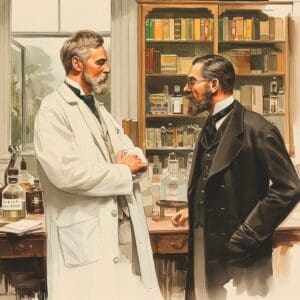
H. G. Wells: The Stolen Bacillus
The Stolen Bacillus is a short story by H. G. Wells, published on June 21, 1894, in The Pall Mall Budget. The story begins in the laboratory of a bacteriologist who shows a visitor a live culture of the cholera bacillus, explaining its ability to devastate entire cities. The visitor, fascinated by the destructive power of the microorganism, listens attentively as the scientist describes the consequences of its spread. However, a momentary distraction allows the stranger to leave in a hurry, which triggers a frantic chase through London. As the tension mounts, the story takes an unexpected turn.
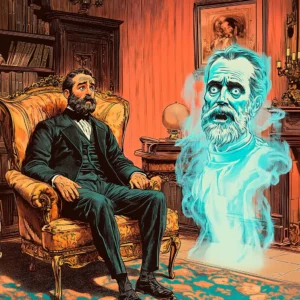
H. G. Wells: The Stolen Body
“The Stolen Body” is a short story by H. G. Wells published in 1898 in The Strand Magazine, combining science fiction with supernatural horror. Mr. Bessel and his colleague Vincey are deeply interested in the study of psychic and spiritual phenomena. Driven by his curiosity, Bessel decides to experiment with astral projection, attempting to separate his mind from his physical body. However, during one of these attempts, something goes wrong and Bessel finds himself outside his body, facing mysterious and puzzling situations as he searches for a way to return to his normal state.
H. G. Wells: The Story of the Late Mr. Elvesham
“The Story of the Late Mr. Elvesham” is a short story by H. G. Wells, first published in May 1896 in The Idler magazine. Edward Eden, a young medical student, is approached in the street by an elderly stranger who invites him to lunch and proposes making him his heir. Intrigued and tempted by the offer, Eden agrees to undergo a series of medical examinations the old man requires as a condition for sealing the deal. What seems like a providential opportunity soon turns into the threshold of a disturbing fate.
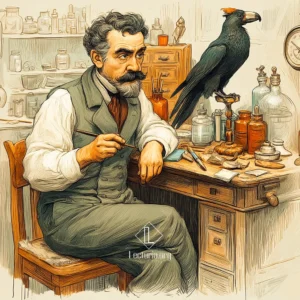
H. G. Wells: The Triumphs of a Taxidermist
“The Triumphs of a Taxidermist” is a short story by H. G. Wells, published on March 3, 1894, in the Pall Mall Gazette and collected in the book The Stolen Bacillus and Other Incidents (1895). The story takes place in the small, messy home of an eccentric taxidermist who, between glasses of whiskey, enthusiastically reveals his trade secrets. With a sarcastic and provocative tone, he describes his most unusual achievements: from faking extinct birds to inventing non-existent species. The story, laden with black humor, pokes fun at scientific credulity and the obsession with collecting curiosities.
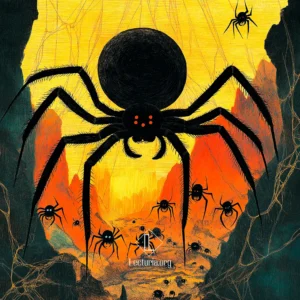
H. G. Wells: The Valley of Spiders
“The Valley of Spiders” is a short story by H. G. Wells, published in March 1903 in Pearson’s Magazine. It tells the story of three horse riders who are pursued across an inhospitable landscape, searching for a pair of fugitives. After several days of marching through a barren and lonely landscape, the men enter a wide, silent valley that appears uninhabited but soon senses an unsettling presence. As the wind intensifies, an unexpected threat emerges from the sky, transforming the hunt into a struggle for survival in an increasingly hostile environment.

H. G. Wells: The Country of the Blind. Summary and analysis
Nunez, a mountaineer from the regions near Quito, accidentally falls into an isolated valley in the Andes, inhabited by a community that has been blind for generations. Convinced that his vision will give him an advantage, and under the motto “In the land of the blind, the one-eyed man is king,” he tries to impose himself on the rest, but the inhabitants do not understand the notion of “seeing” and consider him sick. When his plan to become a leader fails, he falls in love with a young woman from the valley and wants to marry her, but the elders make the marriage conditional on his undergoing an operation to remove his eyes. Although he initially agrees out of love, when he sees the beauty of the visible world for the last time, he changes his mind and flees to the mountains.
Anuncio