
Anuncio
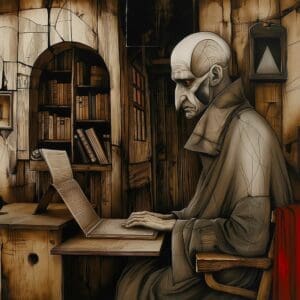
Jorge Luis Borges: A Weary Man’s Utopia
“A Weary Man’s Utopia” (Utopía de un hombre que está cansado), a short story by Jorge Luis Borges published in 1975 in the collection The Book of Sand, is a lyrical tale with deep philosophical roots that recounts the encounter between a twentieth-century man and an inhabitant of the future. The protagonist, Eudoro Acevedo, arrives at a house where he is received by a tall man dressed in gray. During their conversation in Latin, the host reveals an apparently utopian world, without governments, cities, or material possessions. Humanity has abolished the printing press, and each individual creates his own science and art. The inhabitants live in solitude and exercise complete control over their own life and death.

Jorge Luis Borges: Death and the Compass
“Death and the Compass” is a short story by Jorge Luis Borges, first published in May 1942 in the magazine Sur and later included in the collection Ficciones (1944). Dr. Marcelo Yarmolinsky, a delegate to the Third Talmudic Congress, is found dead in his room at the Hôtel du Nord. At the crime scene, a mysterious message is discovered, linked to the first letter of the Name of God. Convinced that behind this death—and those that follow—there lies a mystical and symbolic pattern, the detective Erik Lönnrot ventures into a sinuous labyrinth of clues, determined to uncover who, or who all, is responsible for these murders.

Jorge Luis Borges: Emma Zunz
“Emma Zunz,” a short story by Jorge Luis Borges published in the book El Aleph (1949), tells the story of Emma, a young textile factory worker. Emma receives the news that her father, who was living far away after being unjustly accused of theft, has died due to an overdose of veronal. Grief-stricken and convinced that she knows the culprit behind her father’s misfortune, Emma embarks on a meticulous plan of revenge to restore her father’s honor.
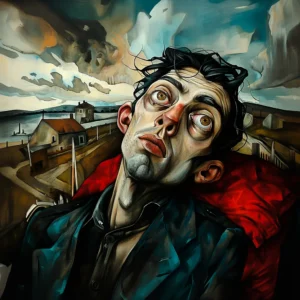
Jorge Luis Borges: Funes, His Memory
“Funes, His Memory” (Funes el memorioso) is a short story by Jorge Luis Borges, first published in June 1942 in the newspaper La Nación, and later included in the book Ficciones (1944). It recounts the story of Ireneo Funes, a young man who, after an accident, acquires a prodigious memory: he can recall every detail of his life and surroundings with absolute precision. The narrator, an alter ego of Borges, reflects on the implications of this ability. Far from turning Funes into a sage, his perfect memory renders him incapable of abstraction or generalization, trapping him in a world of overwhelming details. Borges thus offers a profound meditation on the limits of knowledge and memory, suggesting that forgetting, to a certain extent, is necessary in order to think and to live.

Jorge Luis Borges: The Aleph
“The Aleph” (El Aleph) is one of the most iconic short stories by Jorge Luis Borges, originally published in 1945 in the magazine Sur and later included in the 1949 collection of the same name. In this work, Borges explores the intersection between the infinite and the everyday. The story follows a protagonist obsessed with the memory of his beloved Beatriz Viterbo, who regularly visits the house where she once lived. There, he encounters her cousin, Carlos Argentino Daneri, a mediocre poet and library clerk. During one of these meetings, Daneri reveals the existence of an astonishing object: an “Aleph,” a point in space that contains all the points in the universe.
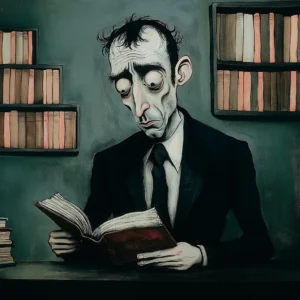
Jorge Luis Borges: The Book of Sand
The Book of Sand (El libro de arena), a story by Jorge Luis Borges published in 1975, tells the story of a man who, in exchange for a valuable Bible and money, acquires a mysterious book of unknown origin and strange characters that seem to have infinite content. As the man tries to understand the nature of the book, he becomes obsessed and isolates himself, which will seriously affect his life.

Jorge Luis Borges: The House of Asterion
The House of Asterion, a short story by Jorge Luis Borges, published in 1947 in Los Anales de Buenos Aires and later included in the collection El Aleph (1949), explores the life of Asterion, a mythical and enigmatic character who lives in a unique, vast and labyrinthine house. Through a first-person narrative, Asterion describes his solitary existence in this mysterious house, where he entertains himself with various games and reflections while awaiting the arrival of the promised Redeemer.

Jorge Luis Borges: The Immortal
“The Immortal,” a story by Jorge Luis Borges from the short story collection ‘El Aleph’ (1949), narrates the intense odyssey of a Roman soldier, Marcus Flaminius Rufus, to find a mythical river that grants immortality. In his quest, the protagonist embarks on an expedition full of dangers and extraordinary discoveries, where he will test his courage and fortitude. After a long journey, he arrives at a remote place inhabited by a tribe of troglodytes, where he receives a terrible revelation about the immortals and their river.

Jorge Luis Borges: The Interloper
The Interloper (La intrusa) is a short story by Jorge Luis Borges, published in 1970 in the book El informe de Brodie. The story is set in Turdera, a town on the outskirts of Buenos Aires, and narrates the life of two brothers, Cristián and Eduardo Nilsen, rough cattle drivers united by violence, pride and a strange loyalty. Their bond begins to strain when a woman, Juliana Burgos, enters their lives and upsets the balance that kept them together. A story with a sordid history that portrays life in the Argentine countryside at a time when women were nothing more than objects.
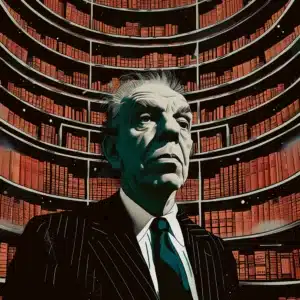
Jorge Luis Borges: The Library of Babel
“The Library of Babel,” a fascinating story by Jorge Luis Borges included in ‘The Garden of Forking Paths (1941)’, imagines a universe composed of an infinite library of hexagonal galleries containing all possible books. In this chaotic and vast cosmos, librarians are engaged in an endless search for absolute knowledge or a book that gives meaning to their existence. Borges explores philosophical and metaphysical concepts such as infinity, the arbitrariness of language, and the human desire to understand an essentially incomprehensible universe. This story is a meditation on the obsession with knowledge and the ultimate meaning of life in a world where everything is already written and yet nothing can be fully understood.

Jorge Luis Borges: Death and the Compass. Summary and analysis
Death and the Compass, written by Jorge Luis Borges in 1942, is a detective story loaded with symbolism. Detective Erik Lönnrot investigates a series of murders connected by a cabalistic pattern. His obsession with logic leads him to interpret a series of clues in search of a solution to the mystery. As he deciphers the deaths, the reader is plunged into a labyrinth of mystical and mysterious concepts. With wit and a unique structure, Borges reflects on logic, chance, and the limits of human knowledge.
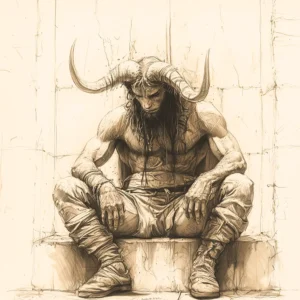
Jorge Luis Borges: The House of Asterion. Summary and analysis
The House of Asterion is a short story by Jorge Luis Borges, published in 1947 in Los Anales de Buenos Aires and later included in El Aleph (1949). It narrates the life of Asterion, a solitary being who inhabits an immense and labyrinthine house. From his perspective, he defends his isolation and describes his games, thoughts, and the strange architecture of his home, where each corridor seems to repeat itself endlessly. Despite his apparent freedom, Asterion longs for the arrival of a redeemer to end his solitude without fully understanding the meaning of his destiny.

Jorge Luis Borges: The Interloper. Summary and analysis
The Interloper (La intrusa) is a short story by Jorge Luis Borges, published in 1970 in the book El informe de Brodie. It tells the story of the Nilsen brothers, rough and lonely men who live together in an isolated house in Turdera. Their life changes when Cristián brings Juliana to live with them, a woman whose presence threatens to disrupt life in the home. The story describes with realism and rawness how the bonds between the brothers begin to change as a silent rivalry grows between them.
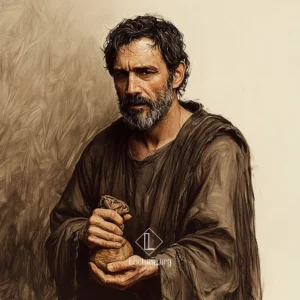
Jorge Luis Borges: Three Versions of Judas. Summary and analysis
In “Three Versions of Judas” (Tres versiones de Judas), Jorge Luis Borges tells the story of Nils Runeberg, a fictional Swedish theologian who devotes his life to studying the figure of Judas Iscariot. In his works, Runeberg develops a series of theories that radically reinterpret Judas’ betrayal, first claiming that his act was a necessary sacrifice in the divine plan and, finally, that Judas was an incarnation of God. As he delves deeper into his thinking, Runeberg moves away from religious orthodoxy, is condemned by theologians, and ends up in tormented isolation. His last work, ignored by all, argues that God’s sacrifice had to be absolute, including infamy and eternal damnation, and that this is why he decided to be Judas. Convinced that he has revealed a divine secret that should not be known, Runeberg goes mad and dies alone after wandering the streets of Malmö.
Anuncio