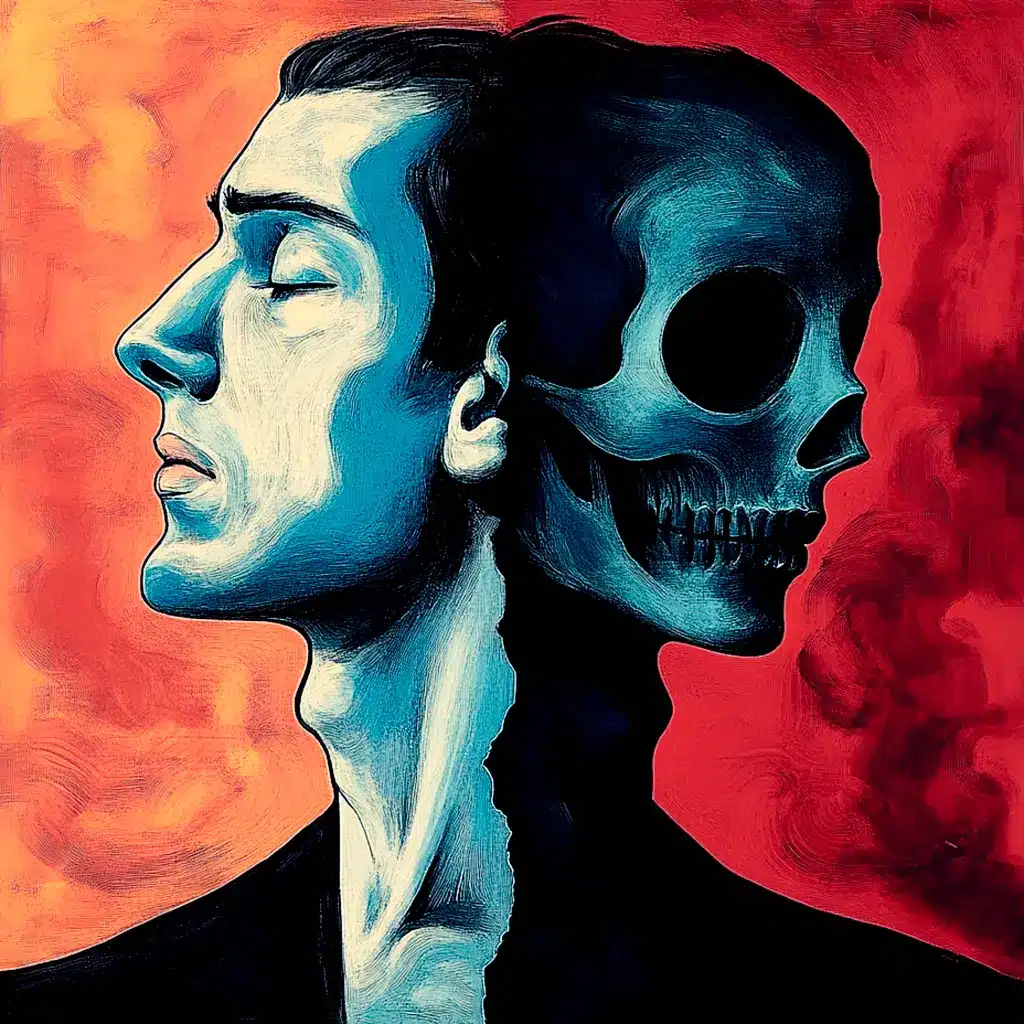
Synopsis: “The Other Side of Death” (La otra costilla de la muerte) is a short story by Gabriel García Márquez, published in 1948 in the newspaper El Espectador and later collected in the book Ojos de perro azul (1974). The story plunges us into the troubled mind of a man who has just lost his twin brother. Awake in the early hours of the morning, surrounded by strange smells and sensations, he is confronted by a disturbing dream that becomes entwined with reality. His brother’s death leads him to reflect on life, death, and the strange connection between the two. Laden with symbolism and a dreamlike atmosphere, the narrative reveals the protagonist’s deep unease, as he feels that his own existence is inexorably bound to that of his dead brother.
The Other Side of Death
Gabriel García Márquez
(Full story)
Without knowing why, he awoke with a start. A sharp smell of violets and formaldehyde, robust and broad, was coming from the other room, mingling with the aroma of the newly opened flowers sent out by the dawning garden. He tried to calm down, to recover the spirit he had suddenly lost in sleep. It must have been dawn now, because outside, in the garden, the sprinkler had begun to sing amidst the vegetables and the sky was blue through the open window. He looked about the shadowy room, trying to explain that sudden, unexpected awakening. He had the impression, the physical certainty, that someone had come in while he had been asleep. Yet he was alone, and the door, locked from the inside, showed no signs of violence. Up above the air over the window a morning star was awakening. He was quiet for a moment, as if trying to loosen the nervous tension that had pushed him to the surface of sleep, and closing his eyes, face up, he began to seek the broken thread of serenity again. His clustered blood broke up in his throat and beyond that, in his chest, his heart despaired robustly, marking, marking an accentuated and light rhythm as if it were coming from some headlong running. He reviewed the previous minutes in his mind. Maybe he’d had a strange dream. It might have been a nightmare. No. There was nothing particular, no reason for any start in ‘that.’
They were traveling in a train – I remember it now – through a countryside – I’ve had this dream frequently – like a still life, sown with false, artificial trees bearing fruit of razors, scissors, and other diverse items – I remember now that I have to get my hair cut – barbershop instruments. He’d had that dream a lot of times but it had never produced that scare in him. There behind a tree was his brother, the other one, his twin, signaling – this happened to me somewhere in real life – for him to stop the train. Convinced of the futility of his message, he began to run after the coach until he fell, panting, his mouth full of froth. It was his absurd, irrational dream, of course, but there was no reason for it to have caused that restless awakening. He closed his eyes again, his temples still pounded by the current of blood that was rising firmly in him like a clenched fist. The train went into an arid, sterile, boring geography, and a pain he felt in his left leg made him turn his attention from the landscape. He observed that on his middle toe – I mustn’t keep on wearing these tight shoes – he had a tumor. In a natural way, and as if he were used to it, he took a screwdriver out of his pocket and extracted the head of the tumor with it. He placed it carefully in a little blue box – can you see colors in dreams? – and he glimpsed, peeping out of the wound, the end of a greasy, yellow string. Without getting upset, as if he had expected that string to be there, he pulled on it slowly with careful precision. It was a long, very long tape, which came out by itself, with no discomfort or pain. A second later he lifted his eyes and saw that the railway coach had emptied out and that the only one left, in another compartment of the train, was his brother, dressed as a woman, in front of a mirror, trying to extract his left eye with a pair of scissors.
Actually, he was displeased with that dream, but he couldn’t explain why it had altered his circulation, because on previous occasions when his nightmares had been hair-raising he had managed to maintain his calm. His hands felt cold. The smell of violets and formaldehyde persisted and became disagreeable, almost aggressive. With his eyes closed, trying to break the rising tempo of his breathing, he tried to find some trivial theme so he could sink into the dream that had been interrupted minutes before. He could think, for example, that in three hours I must go to the funeral parlor to cover the expenses. In the corner a wakeful cricket had raised its chirp and was filling the room with its sharp and cutting throat. The nervous tension began to recede slowly but effectively and he noticed once more the looseness, the laxity of his muscles. He felt that he had fallen on the soft and thick cushion while his body, light and weightless, had been run through by a sweet feeling of beatitude and fatigue and was losing consciousness of its own material structure, that heavy, earthy substance that defined it, placing it in an unmistakable and exact spot on the zoological scale and bearing a whole sum of systems, geometrically defined organs that lifted him up to the arbitrary hierarchy of rational animals. His eyelids, docile now, fell over his corneas in the same natural way with which his arms and legs mingled in a gathering of members that were slowly losing their independence, as if the whole organism had turned into one single, large, total organism, and he – the man – had abandoned his mortal roots so as to penetrate other, deeper and firmer, roots: the eternal roots of an integral and definitive dream. Outside, from the other side of the world, he could hear the cricket’s song growing weaker until it disappeared from his senses, which had turned inward, submerging him in a new and uncomplicated notion of time and space, erasing the presence of that material world, physical and painful, full of insects and acrid smells of violets and formaldehyde.
Gently wrapped in the warm climate of a coveted serenity, he felt the lightness of his artificial and daily death. He sank into a loving geography, into an easy, ideal world, a world like one drawn by a child, with no algebraic equations, with no loving farewells, no force of gravity.
He wasn’t exactly sure how long he’d been like that, between that noble surface of dreams and realities, but he did remember that suddenly, as if his throat had been cut by the slash of a knife, he’d given a start in bed and felt that his twin brother, his dead brother, was sitting on the edge of the bed.
Again, as before, his heart was a fist that rose up into his mouth and pushed him into a leap. The dawning light, the cricket that continued grinding the solitude with its little out-of-tune hand organ, the cool air that came up from the garden’s universe, everything contributed to make him return to the real world once more. But this time he could understand what had caused his start. During the brief minutes of his dozing, and – I can see it now – during the whole night, when he had thought he’d had a peaceful, simple sleep, with no thoughts, his memory had been fixed on one single, constant, invariable image, an autonomous image that imposed itself on his thought in spite of the will and the resistance of the thought itself. Yes. Almost without his noticing it, ‘that’ thought had been overpowering him, filling him, completely inhabiting him, turning into a backdrop that was fixed there behind the other thoughts, giving support, the definitive vertebrae to the mental drama of his day and night. The idea of his twin brother’s corpse had been firmly stuck in the whole center of his life. And now that they had left him there, in his parcel of land now, his eyelids fluttered by the rain, now he was afraid of him.
He never thought the blow would have been so strong. Through the partly opened window the smell entered again, mixed in now with a different smell, of damp earth, submerged bones, and his sense of smell came out to meet it joyfully, with the tremendous happiness of a bestial man. Many hours had already passed since the moment in which he saw it twisting like a badly wounded dog under the sheets, howling, biting out that last shout that filled his throat with salt, using his nails to try to break the pain that was climbing up him, along his back, to the roots of the tumor. He couldn’t forget his thrashing like a dying animal, rebellious at the truth that had stopped in front of him, that had clasped his body with tenacity, with imperturbable constancy, something definitive, like death itself. He saw him during the last moments of his barbarous death throes. When he broke his nails against the walls, clawing at that last piece of life which was slipping away through his fingers, bleeding him, while the gangrene was getting into him through the side like an implacable woman. Then he saw him fall onto the messy bed, with a touch of resigned fatigue, sweating, as his froth-covered teeth drew a horrible, monstrous smile for the world out of him and death began to flow through his bones like a river of ashes.
It was then that I thought about the tumor that had ceased to pain in his stomach. I imagined it as round – now he felt the same sensation – swelling like an interior sun, unbearable like a yellow insect extending its vicious filaments towards the depths of the intestines. (He felt that his viscera had become dislocated inside him as before the imminence of a physiological necessity.) Maybe I’ll have a tumor like his someday. At first it will be a small but growing sphere that will branch out, growing larger in my stomach like a fetus. I will probably feel it when it starts to take on motion, moving inward with the fury of a sleepwalking child, traveling through my intestines blindly – he put his hands on his stomach to contain the sharp pain – its anxious hands held out toward the shadows, looking for the warm matrix, the hospitable uterus that it is never to find; while its hundred feet of a fantastic animal will go on wrapping themselves up into a long and yellow umbilical cord. Yes. Maybe I – the stomach – like this brother who has just died, have a tumor at the root of my viscera. The smell that the garden had sent was returning now, strong, repugnant, enveloped in a nauseating stench. Time seemed to have stopped on the edge of dawn. The morning star had jelled on the glass while the neighboring room, where the corpse had been all the night before, was still exuding its strong formaldehyde message. It was, certainly, a different smell from that of the garden. This was a more anguished, a more specific smell than that mingled smell of unequal flowers. A smell that always, once it was known, was related to corpses. It was the glacial and exuberant smell left with him from the formic aldehyde of amphitheaters. He thought about the laboratory. He remembered the viscera preserved in absolute alcohol; the dissected birds. A rabbit saturated with formaldehyde has its flesh harden, it becomes dehydrated and loses its docile elasticity until it changes into a perpetual, eternalized rabbit. Formaldehyde. Where is this smell coming from? The only way to contain rot. If we men had formaldehyde in our veins we would be like the anatomical specimens submerged in absolute alcohol.
There outside he heard the beating of the increasing rain as it came hammering on the glass of the partly open window. A cool, joyful, and new air came in, loaded with dampness. The cold of his hands intensified, making him feel the presence of the formaldehyde in his arteries; as if the dampness of the courtyard had come into him down to the bones. Dampness. There’s a lot of dampness ‘there.’ With a certain displeasure he thought about the winter nights when the rain will pass through the grass and the dampness will come to rest on his brother’s side, circulate through his body like a concrete current. It seemed to him that the dead had need of a different circulatory system that hurled them toward another irremediable and final death. At the moment he didn’t want it to rain any more, he wanted summer to be an eternal, dominant season. Because of his thoughts, he was displeased by the persistence of that damp clatter on the glass. He wanted the clay of cemeteries to be dry, always dry, because it made him restless to think that after two weeks, when the dampness begins to run through the marrow, there would no longer be another man equal, exactly equal to him under the ground.
Yes. They were twin brothers, exact, whom no one could distinguish at first sight. Before, when they both were living their separate lives, they were nothing but two twin brothers, simple and apart like two different men. Spiritually there was no common factor between them. But now, when rigidity, the terrible reality, was climbing up along his back like an invertebrate animal, something had dissolved in his integral atmosphere, something that sounded like an emptiness, as if a precipice had opened up at his side, or as if his body had suddenly been sliced in two by an axe; not that exact, anatomical body under a perfect geometrical definition; not that physical body that now felt fear; another body, rather, that was coming from beyond his, that had been sunken with him in the liquid night of the maternal womb and was climbing up with him through the branches of an ancient genealogy; that was with him in the blood of his four pairs of great-grandparents and that came from way back, from the beginning of the world, sustaining with its weight, with its mysterious presence, the whole universal balance. It might be that he had been in the blood of Isaac and Rebecca, that it was his other brother who had been born shackled to his heel and who came tumbling along generation after generation, night after night, from kiss to kiss, from love to love, descending through arteries and testicles until he arrived, as on a night voyage at the womb of his recent mother. The mysterious ancestral itinerary was being presented to him now as painful and true, now that the equilibrium had been broken and the equation definitively solved. He knew that something was lacking for his personal harmony, his formal and everyday integrity: Jacob had been irremediably freed from his ankles!
During the days when his brother was ill he hadn’t had this feeling, because the emaciated face, transfigured by fever and pain, with the grown beard, had been quite different from his.
Once he was motionless, lying out on top of his total death, a barber was called to ‘arrange’ the corpse. He was present, leaning tightly against the wall, when the man dressed in white arrived bearing the clean instruments of his profession … With the precision of a master he covered the dead man’s beard with lather – the frothy mouth: that was how I saw him before he died – and slowly, as one who goes about revealing a tremendous secret, he began to shave him. It was then that he was assaulted by ‘that’ terrible idea. As the pale and earthen face of his twin brother emerged under the passage of the razor, he had the feeling that the corpse there was not a thing that was alien to him but was made from his same earthy substance, that it was his own repetition … He had the strange feeling that his kin had extracted his image from the mirror, the one he saw reflected in the glass when he shaved. Now that image, which used to respond to every movement of his, had gained independence. He had watched it being shaved other times, every morning. But now he was witnessing the dramatic experience of another man’s taking the beard off the image in his mirror, his own physical presence unneeded. He had the certainty, the assurance, that if he had gone over to a mirror at that moment he would have found it blank, even though physics had no precise explanation for the phenomenon. It was an awareness of splitting in two! His double was a corpse! Desperate, trying to react, he touched the firm wall that rose up in him by touch, a kind of current of security. The barber finished his work and with the tip of his scissors closed the corpse’s eyelids. Night left him trembling inside, with the irrevocable solitude of the plucked corpse. That was how exact they were. Two identical brothers, disquietingly repeated.
It was then, as he observed how intimately joined those two natures were, that it occurred to him that something extraordinary, something unexpected, was going to happen. He imagined that the separation of the two bodies in space was just appearance, while in reality the two of them had a single, total nature. Maybe when organic decomposition reaches the dead one, he, the living one, will begin to decay also within his animated world.
He could hear the rain beating more strongly on the panes and the cricket suddenly snapped his string. His hands were now intensely cold with a long, dehumanized coldness. The smell of formaldehyde, stronger now, made him think about the possibility of reaching the rottenness that his twin brother was communicating to him from there, from his frozen hole in the ground. That’s absurd! Maybe the phenomenon is the opposite: the influence must be exercised by the one who remained with life, with his energy, with his vital cell! Maybe – on this level – he and his brother, too, will remain intact, sustaining a balance between life and death as they defend themselves against putrefaction. But who can be sure of it? Wasn’t it just as possible that the buried brother would remain incorruptible while rottenness would invade the living one with all its blue octopuses?
He thought that the last hypothesis was the most probable and resigned himself to wait for the arrival of his tremendous hour. His flesh had become soft, adipose, and he thought he could feel a blue substance covering him all over. He sniffed down below for the coming of his own bodily odors, but only the formaldehyde from the next room agitated his olfactory membranes with an icy, unmistakable shudder. Nothing worried him after that. The cricket in its corner tried to start its ballad up again while a thick, exact drop began to run along the ceiling in the very center of the room. He heard it drop without surprise because he knew that the wood was old in that spot, but he imagined that drop, formed from cool, good, friendly water, coming from the sky, from a better life, one that was broader and not so full of idiotic phenomena like love or digestion or twinship. Maybe that drop would fill the room in the space of an hour or in a thousand years and would dissolve that mortal armor, that vain substance, which perhaps – why not? – between brief instants would be nothing but a sticky mixture of albumen and whey. Everything was equal now. Only his own death came between him and his grave. Resigned, he listened to the drop, thick, heavy, exact, as it dripped in the other world, in the mistaken and absurd world of rational creatures.
THE END