Synopsis: “Aged Folk” (Les vieux) is a short story by the French writer Alphonse Daudet, published in Le Figaro on October 23, 1868, and later included in the collection Lettres de mon moulin (1869). A miller from Provence receives a letter from a friend in Paris asking him to do something unusual: to travel to the village of Eyguières to visit his grandparents, whom he hasn’t seen in over ten years. Reluctantly, the miller sets out on the journey to a humble house next to a convent, where he finds two elderly people who welcome him with overwhelming emotion and heartfelt hospitality.
Aged Folk
Alphonse Daudet
(Full story)
“A LETTER, PÈRE Azan?”
“Yes, monsieur; and it comes from Paris.”
He was quite proud, that worthy old Azan, that it came from Paris. I was not. Something told me that that Parisian missive from the rue Jean-Jacques, dropping thus upon my table unexpectedly, and so early in the morning, would make me lose my whole day. I was not mistaken, — and you shall see why.
“You must do me a service, my friend,” said the letter. “Close your mill for a day, and go to Eyguières. Eyguières is a large village, three or four leagues from your mill, — a pleasant walk. When you get there, ask for the Orphans’ Convent. The first house beyond the convent is a low building with gray shutters, and a small garden behind it. Enter without knocking, — the door is always open, — and as you enter, call out very loud: ‘Good-day, worthy people! I am a friend of Maurice.’ On which you will see two little old persons — oh! but old, old, ever so old — stretching out their hands to you from their big armchairs; and you are to kiss them for me, with all your heart, as if they were yours, your own friends. Then you will talk. They will talk to you of me and nothing else; they will say a lot of foolish things, which you are to listen to without laughing. You won’t laugh, will you? They are my grandparents; two beings whose very life I am, and who have not seen me these ten years… Ten years, a long time! But how can I help it? Paris clutches me. And they, they are so old that if they came to see me they would break to bits on the way… Happily, you are there, my dear miller, and, in kissing you, these poor old people will fancy they are kissing me. I have so often told them about you, and of the good friendship that—”
The devil take good friendship! Just this very morning, when the weather is so beautiful! but not at all fit to tramp along the roads; too much mistral, too much sun, a regular Provence day. When that cursed letter came, I had just picked out my shelter between two rocks, where I dreamed of staying all day like a lizard, drinking light and listening to the song of the pines. Well, I could not help myself. I shut up the mill, grumbling, and hid the key. My stick, my pipe, and off I went.
I reached Eyguières in about two hours. The village was deserted; everybody was in the fields. From the elms in the courtyards, white with dust, the grasshoppers were screaming. To be sure, in the square before the mayor’s office, a donkey was sunning himself, and a flock of pigeons were dabbling in the fountain before the church, but no one able to show me the Orphans’ Convent. Happily, an old witch suddenly appeared, crouching and knitting in the angle of her doorway. I told her what I was looking for; and as she was a witch of very great power, she had only to raise her distaff, and, behold! the Orphans’ Convent rose up before me. It was a large, sullen, black house, proud of exhibiting above its arched portal an old cross of red freestone with Latin around it. Beside this house, I saw another, very small; gray shutters, garden behind it. I knew it directly, and I entered without knocking.
All my life I shall remember that long, cool, quiet corridor, the walls rose-tinted, the little garden quivering at the other end, and seen through a thin blind. It seemed to me that I was entering the house of some old bailiff of the olden time of Sedaine. At the end of the passage, on the left, through a half-opened door, I heard the tick-tack of a large clock and the voice of a child — a child in school — who was reading aloud, and pausing at each syllable: “Then — Saint — I-re-ne-us — cri-ed — out — I — am — the — wheat — of — the Lord — I — must — be — ground — by — the — teeth — of — these — an-i-mals.” I softly approached the door and looked in.
In the quiet half-light of a little room, an old, old man with rosy cheeks, wrinkled to the tips of his fingers, sat sleeping in a chair, his mouth open, his hands on his knees. At his feet, a little girl dressed in blue — with a great cape and a linen cap, the orphans’ costume — was reading the life of Saint Irenæus in a book that was bigger than herself. The reading had operated miraculously on the entire household. The old man slept in his chair, the flies on the ceiling, the canaries in their cage at the window, and the great clock snored: tick-tack, tick-tack. Nothing was awake in the room but a broad band of light, which came, straight and white, between the closed shutters, full of lively sparkles and microscopic whirlings.
Amid this general somnolence, the child went gravely on with her reading: —
“Im-me-di-ate-ly — two — li-ons — dart-ed — upon — him — and — ate — him — up.” At this moment I entered the room. The lions of Saint Irenæus darting into the room could not have produced greater stupefaction. A regular stage effect! The little one gave a cry, the big book fell, the flies and the canaries woke, the clock struck, the old man started up, quite frightened, and I myself, being rather troubled, stopped short on the sill of the door, and called out very loud: “Good-day, worthy people! I am Maurice’s friend.”
Oh, then! if you had only seen him, that old man, if you had only seen how he came to me with outstretched arms, embracing me, pressing my hands, and wandering about the room, crying out: —
“Mon Dieu! mon Dieu!”
All the wrinkles of his face were laughing. He was red. He stuttered: —
“Ah! monsieur — ah! monsieur.”
Then he went to the back of the room and called: —
“Mamette!”
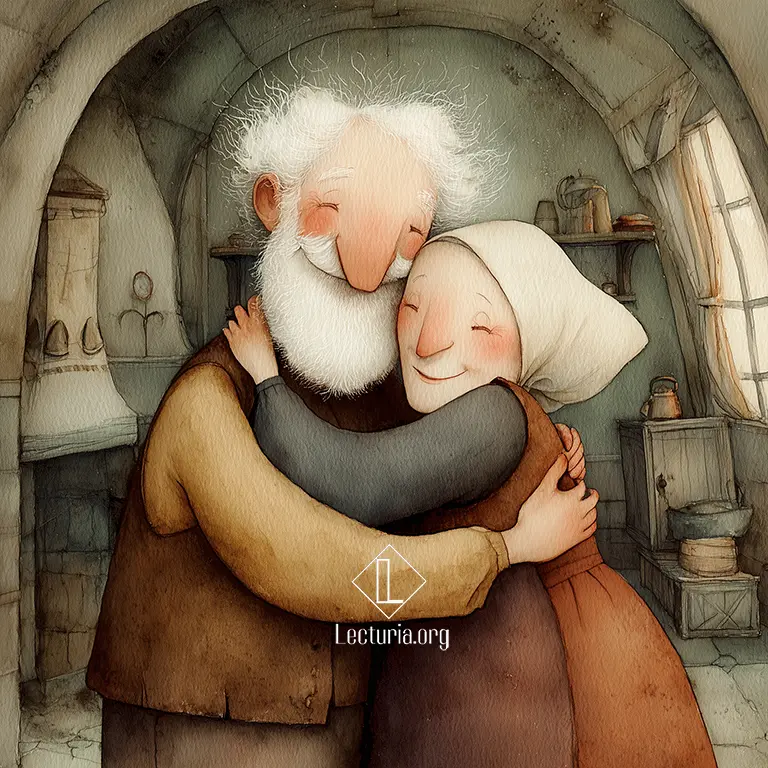
A door opened, a trot of mice in the corridor — it was Mamette. Nothing prettier than that little old woman with her mob-cap, her brown gown, and the embroidered handkerchief which she held in her hand in the olden fashion. Most affecting thing! the two were like each other. With a false front and yellow bows to his cap, he too might be called Mamette. Only, the real Mamette must have wept a great deal in her life, for she was even more wrinkled than he. Like him, she too had an orphan with her, a little nurse in a blue cape who never left her; and to see these old people protected by those orphans was indeed the most touching thing you can imagine.
On entering, Mamette began to make me a deep curtsey, but a word of the old man stopped her In the middle of it: —
“A friend of Maurice.”
Instantly she trembled, she wept, dropped her handkerchief, grew red, very red, redder than he. Those aged folk! who have hardly a drop of blood in their veins, how it flies to their face at the least emotion!
“Quick, quick, a chair,” said the old lady to her little girl.
“Open the shutters,” said the old man to his.
Then taking me each by a hand they led me, trotting along, to the window the better to see me. The armchairs were placed; I sat between the two on a stool, the little Blues behind us, and the questioning began: —
“How is he? What is he doing? Why doesn’t he come? Is he happy?”
Patati, patata! and so on for two hours.
I answered as best I could all their questions, giving such details about my friend as I knew, and boldly inventing others that I did not know; being careful to avoid admitting that I had never noticed whether his windows closed tightly and what coloured paper he had on his walls.
“The paper of his bedroom? blue, madame, light blue, with garlands of flowers—”
“Really!” said the old lady, much affected; then she added, turning to her husband: “He is such a dear lad!”
“Yes, yes! a dear lad!” said the other, with enthusiasm.
And all the time that I was speaking they kept up between them little nods, and sly laughs and winks, and knowing looks; or else the old man came closer to say in my ear: —
“Speak louder, she is a little hard of hearing.”
And she on her side: —
“A little louder, if you please. He doesn’t hear very well.”
Then I raised my voice, and both of them thanked me with a smile; and in those faded smiles, — bending toward me, seeking in the depths of my eyes the image of their Maurice, — I was, myself, quite moved to see that image, vague, veiled, almost imperceptible, as if I beheld my friend smiling to me from afar through a mist Suddenly the old man sat upright in his chair.
“I have just thought, Mamette, — perhaps he has not breakfasted!”
And Mamette, distressed, throws up her arms.
“Not breakfasted! oh, heavens!”
I thought they were still talking of Maurice, and I was about to say that that worthy lad never waited later than noon for his breakfast. But no, it was of me they were thinking; and it was indeed a sight to see their commotion when I had to own that I was still fasting.
“Quick! set the table, little Blues! That table in the middle of the room — the Sunday cloth — the flowered plates. And no laughing, if you please! Make haste, make haste!”
And haste they made. Only time to break three plates and breakfast was served.
“A good little breakfast,” said Mamette, leading me to the table; “only, you must eat it alone. We have eaten already.”
Poor old people! at whatever hour you took them, they had “eaten already.”
Mamette’s good little breakfast was a cup of milk, dates, and a barquette, a kind of shortcake, no doubt enough to feed her canaries for a week; and to think that I, alone, I ate up all their provisions! I felt the indignation around the table; the little Blues whispered and nudged each other; and those canaries in their cage, — I knew they were saying: “Oh! that monsieur, he is eating up the whole of the barquette!”
I did eat it all, truly, almost without perceiving that I did so, preoccupied as I was by looking round that light and placid room, where floated, as it were, the fragrance of things ancient. Especially noticeable were two little beds from which I could not detach my eyes. Those beds, almost two cradles, I pictured them in the morning at dawn, still inclosed within their great fringed curtains. Three o’clock strikes. That is the hour when old people wake.
“Are you asleep, Mamette?”
“No, my friend.”
“Isn’t Maurice a fine lad?”
“Yes, yes, a fine lad.”
And from that I imagined a long conversation by merely looking at the little beds of the two old people, standing side by side.
During this time a terrible drama was going on at the other end of the room before a closet. It concerned reaching up to the top shelf for a certain bottle of brandied cherries which had awaited Maurice’s return for the last ten years. The old people now proposed to open it for me. In spite of Mamette’s supplications the husband was determined to get the cherries himself, and, mounted on a chair to the terror of his wife, he was striving to reach them. You can see the scene from here: the old man trembling on the points of his toes, the little Blues clinging to his chair, Mamette behind him, breathless, her arms extended, and, pervading all, a slight perfume of bergamot exhaled from the open closet and the great piles of unbleached linen therein contained. It was charming.
At last, after many efforts, they succeeded in getting it from the closet, that famous bottle, and with it an old silver cup, Maurice’s cup when he was little. This they filled with cherries to the brim — Maurice was so fond of cherries! And while the old man served me, he whispered in my ear, as if his mouth watered: —
“You are very lucky, you, to be the one to eat them. My wife put them up. You’ll taste something good.”
Alas! his wife had put them up, but she had forgotten to sweeten them. They were atrocious, your cherries, my poor Mamette — But that did not prevent me from eating them all without blinking.
The meal over, I rose to take leave of my hosts. They would fain have kept me longer to talk of that dear lad, but the day was shortening, the mill was far, and I had to go.
The old man rose when I did.
“Mamette, my coat; I will accompany him as far as the square.”
I felt very sure that in her heart Mamette thought it too cool for the old man to be out, but she did not show it. Only, as she helped him to put his arms into the sleeves of his coat, a handsome snuff-coloured coat with mother-of-pearl buttons, I heard the dear creature say to him softly: —
“You won’t be late, will you?”
And he, with a roguish air: —
“Hey! hey! I don’t know — perhaps not.”
Thereupon they looked at each other, laughing, and the little Blues laughed to see them laugh, and the canaries laughed too, in their cage, after their fashion. Between ourselves I think the smell of those cherries had made them all a little tipsy.
Daylight was fading as we left the house, grandpapa and I. A little Blue followed at a distance to bring him back; but he did not see her, and seemed quite proud to walk along, arm in arm with me, like a man. Mamette, beaming, watched us from the sill of her door with pretty little nods of her head that seemed to say: “See there! my poor man, he can still walk about.”
THE END