Synopsis: “Erostratus” (Érostrate) is a short story by Jean-Paul Sartre, published in 1939 in the book Le Mur. It tells the story of a solitary and resentful man who observes humanity with a mixture of superiority and revulsion. Obsessed with the pursuit of infamous glory and inspired by the figure of Erostratus—who in antiquity set fire to the Temple of Artemis in Ephesus for the sole purpose of passing into posterity—he acquires a revolver and begins to plan a crime that will grant him the fame he believes he needs in order to transcend his own insignificance.
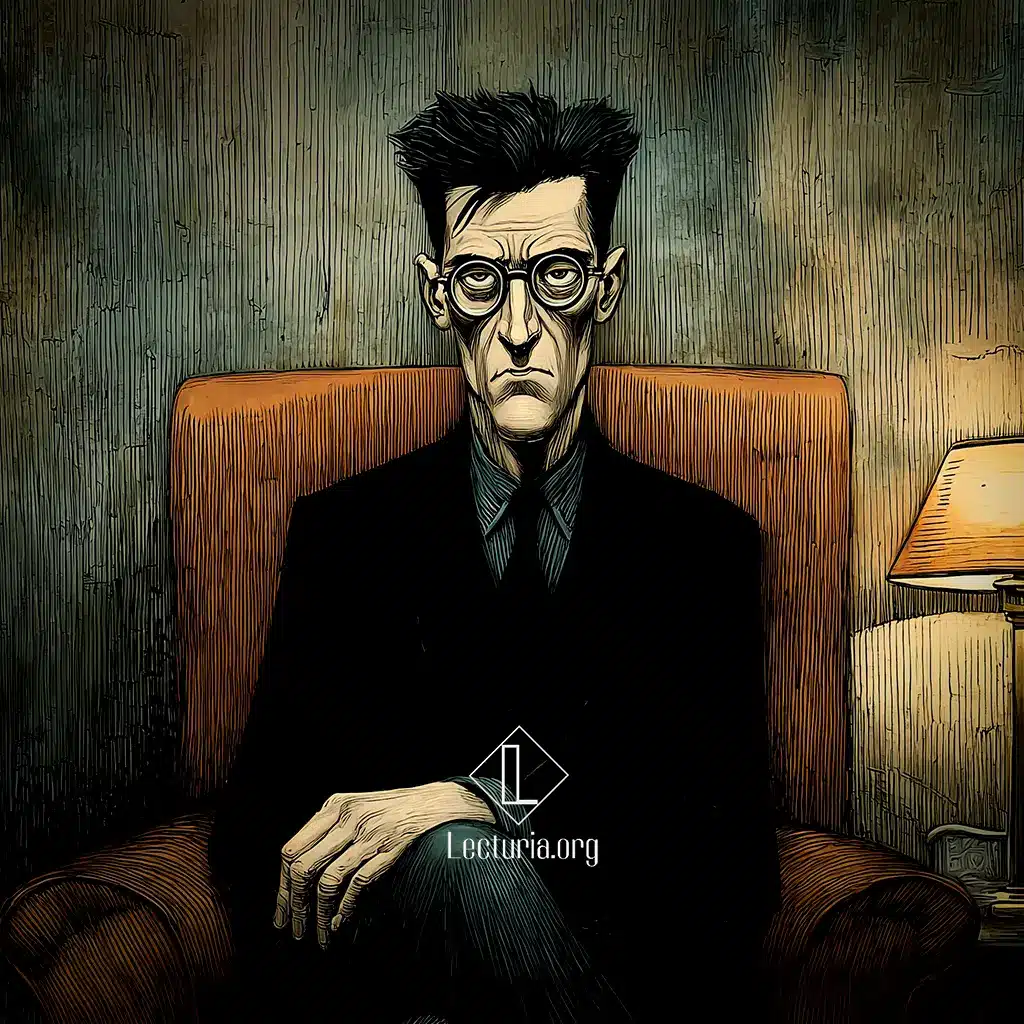
Erostratus
Jean Paul Sartre
(Full story)
You really have to see men from above. I put out the light and went to the window: they never suspected for a moment you could watch them from up there. They’re careful of their fronts, sometimes of their backs, but their whole effect is calculated for spectators of about five feet eight. Who ever thought about the shape of a derby hat seen from the seventh floor? They neglect protecting their heads and shoulders with bright colors and garish clothes, they don’t know how to fight this great enemy of Humanity, the downward perspective. I leaned on the window sill and began to laugh: where was this wonderful upright stance they’re so proud of: they were crushed against the sidewalk and two long legs jumped out from under their shoulders.
On a seventh floor balcony: that’s where I should have spent my whole life. You have to prop up moral superiorities with material symbols or else they’ll tumble. But exactly what is my superiority over men? Superiority of position, nothing more: I have placed myself above the human within me and I study it. That’s why I always liked the towers of Notre-Dame, the platforms of the Eiffel Tower, the Sacré-Coeur, my seventh floor on the Rue Delambre. These are excellent symbols.
Sometimes I had to go down into the street. To the office, for example. I stifled. It’s much harder to consider people as ants when you’re on the same plane as they are: they touch you. Once I saw a dead man in the street. He had fallen on his face. They turned him over, he was bleeding. I saw his open eyes and his cockeyed look and all the blood. I said to myself, “It’s nothing, it’s no more touching then wet paint. They painted his nose red, that’s all.” But I felt a nasty softness in my legs and neck and I fainted. They took me into a drugstore, gave me a few slaps on the face and a drink. I could have killed them.
I knew they were my enemies but they didn’t know it. They liked each other, they rubbed elbows; they would even have given me a hand, here and there, because they thought I was like them. But if they could have guessed the least bit of the truth, they would have beaten me. They did later, anyhow. When they got me and knew who I was, they gave me the works; they beat me up for two hours in the station house, they slapped me and punched me and twisted my arms, they ripped off my pants and to finish they threw my glasses on the floor and while I looked for them, on all fours, they laughed and kicked me. I always knew they’d end up beating me; I’m not strong and I can’t defend myself. Some of them had been on the lookout for me for a long time: the big ones. In the street they’d bump into me to see what I’d do. I said nothing. I acted as if I didn’t understand. But they still got me. I was afraid of them: it was a foreboding. But don’t think I didn’t have more serious reasons for hating them.
As far as that was concerned, everything went along much better starting from the day I bought a revolver. You feel strong when you assiduously carry on your person something that can explode and make a noise. I took it every Sunday, I simply put it in my pants pocket and then went out for a walk—generally along the boulevards. I felt it pulling at my pants like a crab, I felt it cold against my thigh. But little by little it got warmer with the contact of my body. I walked with a certain stiffness, I looked like a man with a hard-on, with his thing sticking out at every step. I slipped my hand in my pocket and felt the object. From time to time I went into a urinoir—even in there I had to be careful because I often had neighbors—I took out my revolver, I felt the weight of it, I looked at its black checkered butt and its trigger that looked like a half-closed eyelid. The others, the ones who saw me from the outside, thought I was pissing. But I never piss in the urinoirs.
One night I got the idea of shooting people. It was a Saturday evening, I had gone out to pick up Lea, a blonde who works out in front of a hotel on the Rue Montparnasse. I never had intercourse with a woman: I would have felt robbed. You get on top of them, of course, but they eat you up with their big hairy mouth and, from what I hear, they’re the ones—by a long shot—who gain on the deal. I don’t ask anybody for anything, but I don’t give anything, either. Or else I’d have to have a cold, pious woman who would give in to me with disgust. The first Saturday of every month I went to one of the rooms in the Hotel Duquesne with Lea. She undressed and I watched her without touching her. Sometimes I went off in my pants all by myself, other times I had time to get home and finish it That night I didn’t find her. I waited for a little while and, as I didn’t see her coming, I supposed she had a cold. It was the beginning of January and it was very cold. I was desolated: I’m the imaginative kind and I had pictured to myself all the pleasure I would have gotten from the evening. On the Rue Odessa there was a brunette I had often noticed, a little ripe but firm and plump: I don’t exactly despise ripe women: when they’re undressed they look more naked than the others. But she didn’t know anything of my wants and I was a little scared to ask her right off the bat. And then I don’t care too much for new acquaintances: these women can be hiding some thug behind a door, and after, the man suddenly jumps out and takes your money. You’re lucky if you get off without a beating. Still, that evening I had nerve, I decided to go back to my place, pick up the revolver and try my luck.
So when I went up to this woman, fifteen minutes later, my gun was in my pocket and I wasn’t afraid of anything. Looking at her closely, she seemed rather miserable. She looked like my neighbor across the way, the wife of the police sergeant, and I was very pleased because I’d been wanting to see her naked for a long time. She dressed with the window open when the sergeant wasn’t there, and I often stayed behind my curtain to catch a glimpse of her. But she always dressed in the back of the room.
There was only one free room in the Hotel Stella, on the fifth floor. We went up. The woman was fairly heavy and stopped to catch her breath after each step. I felt good: I have a wiry body, in spite of my belly, and it takes more than five floors to wind me. On the fifth floor landing, she stopped and put her right hand to her heart and breathed heavily. She had the key to the room in her left hand.
“It’s a long way up,” she said, trying to smile at me. Without answering, I took the key from her and opened the door. I held my revolver in my left hand, pointing straight ahead through the pocket, and I didn’t let go of it until I switched the light on. The room was empty. They had a little square of green soap on the washbasin, for a one-shot. I smiled: I don’t have much to do with bidets and little squares of soap. The woman was still breathing heavily behind me and that excited me. I turned; she put out her lips towards me. I pushed her away.
“Undress,” I told her.
There was an upholstered armchair; I sat down and made myself comfortable. It’s at times like this I wish I smoked. The woman took off her dress and stopped, looking at me distrustfully.
“What’s your name?” I asked, leaning back.
“Renée.”
“All right, Renée, hurry up. I’m waiting.”
“You aren’t going to undress?”
“Go on,” I said, “don’t worry about me.”
She dropped her panties, then picked them up and put them carefully on top of her dress along with her brassiere.
“So you’re a little lazybones, honey?” she asked me, “You want your little girl to do all the work?”
At the same time she took a step towards me, and, leaning her hands on the arm of the chair, tried heavily to kneel between my legs. I got up brusquely.
“None of that,” I told her.
She looked at me with surprise.
“Well, what do you want me to do?”
“Nothing. Just walk. Walk around. I don’t want any more from you.”
She began to walk back and forth awkwardly. Nothing annoys women more than walking when they’re naked. They don’t have the habit of putting their heels down flat. The whore arched her back and let her arms hang. I was in heaven: there I was, calmly sitting in an armchair, dressed up to my neck, I had even kept my gloves on and this ripe woman had stripped herself naked at my command and was turning back and forth in front of me. She turned her head towards me, and, for appearance, smiled coquettishly.
“You think I’m pretty? You’re getting an eyeful?”
“Don’t worry about that.”
“Say,” she asked with sudden indignation, “do you think you’re going to make me walk up and down like this very long?”
“Sit down.”
She sat on the bed and we watched each other in silence. She had gooseflesh. I could hear the ticking of an alarm clock from the other side of the wall. Suddenly I told her:
“Spread your legs.”
She hesitated a fraction of a second then obeyed. I looked between her legs and turned up my nose. Then I began to laugh so hard that tears came to my eyes. I said, simply, “Look at that!”
And I started laughing again.
She looked at me, stupefied, then blushed violently and clapped her legs shut.
“Bastard,” she said between her teeth.
But I laughed louder, then she jumped up and took her brassiere from the chair.
“Hey!” I said, “it isn’t over. I’m going to give you fifty francs after a while, but I want my money’s worth.”
She picked up her panties nervously.
“I’ve had enough, get it? I don’t know what you want. And if you had me come up here to make a fool out of me… .”
Then I took out my revolver and showed it to her. She looked at me seriously and dropped the panties without a word.
“Walk,” I told her, “walk around.”
She walked around for another five minutes. Then I gave her my cane and made her do exercises. When I felt my drawers were wet I got up and gave her a fifty-franc note. She took it.
“So long,” I added. “I don’t think I tired you out very much for the money.”
I went out, I left her naked in the middle of the room, the brassiere in one hand and the fifty-franc note in the other. I didn’t regret the money I spent; I had dumbfounded her and it isn’t easy to surprise a whore. Going down the stairs I thought, “That’s what I want. To surprise them all.” I was happy as a child. I had brought along the green soap and after I reached home I rubbed it under the hot water for a long time until there was nothing left of it but a thin film between my fingers and it looked like a mint candy someone had sucked on for a long time.
But that night I woke up with a start and I saw her face again, her eyes when I showed her my gun, and her fat belly that bounced up and down at every step.
What a fool, I though. And I felt bitter remorse: I should have shot her while I was at it, shot that belly full of holes. That night and three nights afterward, I dreamed of six little red holes grouped in a circle about the navel.
As a result, I never went out without my revolver. I looked at people’s backs, and I imagined, from their walk, the way they would fall if I shot them. I was in the habit of hanging around the Châtelet every Sunday when the classical concerts let out About six o’clock I heard a bell ring and the ushers came to fasten back the plate glass doors with hooks. This was the beginning: the crowd came out slowly; the people walked with floating steps, their eyes still full of dreams, their hearts still full of pretty sentiments. There were a lot of them who looked around in amazement: the street must have seemed quite strange to them. Then they smiled mysteriously: they were passing from one world to another. I was waiting for them in this other world. I slid my right hand into my pocket and gripped the gun butt with all my strength. After a while, I saw myself shooting them. I knocked them off like clay pipes, they fell, one after the other and the panic-stricken survivors streamed back into the theatre, breaking the glass in the doors. It was an exciting game: when it was over, my hands were trembling and I had to go to Dreher’s and drink a cognac to get myself in shape.
I wouldn’t have killed the women. I would have shot them in the kidneys. Or in the calves, to make them dance.
I still hadn’t decided anything. But I did everything just as though my power of decision had stopped. I began with minor details. I went to practice in a shooting gallery at DenfertRochereau. My scores weren’t tremendous, but men are bigger targets, especially when you shoot point-blank. Then I arranged my publicity. I chose a day when all my colleagues would be together in the office. On Monday morning. I was always very friendly with them, even though I had a horror of shaking their hands. They took off their gloves to greet you; they had an obscene way of undressing their hand, pulling the glove back and sliding it slowly along the fingers, unveiling the fat, wrinkled nakedness of the palm. I always kept my gloves on.
We never did much on Mondays. The typist from the commercial service came to bring us receipts. Lemercier joked pleasantly with her and when she had gone, they described her charms with a blasé competence. Then they talked about Lindbergh. They liked Lindbergh. I told them:
“I like the black heroes.”
“Negroes?” Masse asked.
“No, black as in Black Magic. Lindbergh is a white hero. He doesn’t interest me.”
“Go see if it’s easy to cross the Atlantic,” Bouxin said sourly.
I told them my conception of the black hero.
“An anarchist,” Lemercier said.
“No,” I said quietly, “the anarchists like their own kind of men.”
“Then it must be a crazy man.”
But Masse, who had some education, intervened just then.
“I know your character,” he said to me. “His name is Erostratus. He wanted to become famous and he couldn’t find anything better to do than to burn down the temple of Ephesus, one of the seven wonders of the world.”
“And what was the name of the man who built the temple?”
“I don’t remember,” he confessed. “I don’t believe anybody knows his name.”
“Really? But you remember the name of Erostratus? You see, he didn’t figure things out too badly.”
The conversation ended on these words, but I was quite calm. They would remember it when the time came. For myself, who, until then, had never heard of Erostratus, his story was encouraging. He had been dead for more than two thousand years and his act was still shining like a black diamond. I began to think that my destiny would be short and tragic. First it frightened me but I got used to it. If you look at it a certain way, it’s terrible, but on the other hand, it gives the passing moment considerable force and beauty. I felt a strange power in my body when I went down into the street. I had my revolver on me, the thing that explodes and makes noise. But I no longer drew my assurance from that, it was from myself: I was a being like a revolver, a torpedo or a bomb. I too, one day at the end of my somber life, would explode and light the world with a flash as short and violent as magnesium. At that time I had the same dream several nights in a row. I was an anarchist. I had put myself in the path of the Tsar and I carried an infernal machine on me. At the appointed hour, the cortège passed, the bomb exploded and we were thrown into the air, myself, the Tsar, and three gold-braided officers, before the eyes of the crowd.
I now went for weeks on end without showing up at the office. I walked the boulevards in the midst of my future victims or locked myself in my room and made my plans. They fired me at the beginning of October. Then I spent my leisure working on the following letter, of which I made 102 copies:
Monsieur:
You are a famous man and your works sell by the thousands. I am going to tell you why: because you love men. You have humanism in your blood: you are lucky. You expand when you are with people; as soon as you see one of your fellows, even without knowing him, you feel sympathy for him. You have a taste for his body, for the way he is jointed, for his legs which open and close at will, and above all for his hands: it pleases you because he has five fingers on each hand and he can set his thumb against the other fingers. You are delighted when your neighbor takes a cup from the table because there is a way of taking it which is strictly human and which you have often described in your works; less supple, less rapid than that of a monkey, but is it not so much more intelligent? You also love the flesh of man, his look of being heavily wounded with re-education, seeming to re-invent walking at every step, and his famous look which even wild beasts cannot bear. So it has been easy for you to find the proper accent for speaking to man about himself: a modest, yet frenzied accent. People throw themselves greedily upon your books, they read them in a good armchair, they think of a great love, discreet and unhappy, which you bring them and that makes up for many things, for being ugly, for being cowardly, for being cuckolded, for not getting a raise on the first of January. And they say willingly of your latest book: it’s a good deed.
I suppose you might be curious to know what a man can be like who does not love men. Very well, I am such a man, and I love them so little that soon I am going out and kill half a dozen of them: perhaps you might wonder why only half a dozen? Because my revolver has only six cartridges. A monstrosity, isn’t it? And moreover, an act strictly impolitic? But I tell you I cannot love them. I understand very well the way you feel. But what attracts you to them disgusts me. I have seen, as you, men chewing slowly, all the while keeping an eye on everything, the left hand leafing through an economic review. Is it my fault I prefer to watch the sea-lions feeding? Man can do nothing with his face without its turning into a game of physiognomy. When he chews, keeping his mouth shut, the corners of his mouth go up and down, he looks as though he were passing incessantly from serenity to tearful surprise. You love this, I know, you call it the watchfulness of the Spirit. But it makes me sick; I don’t know why; I was born like that.
If there were only a difference of taste between us I would not trouble you. But everything happens as if you had grace and I had none. I am free to like or dislike lobster Newburg, but if I do not like men I am a wretch and can find no place in the sun. They have monopolized the sense of life. I hope you will understand what I mean. For the past 33 years I have been beating against closed doors above which is written: “No entrance if not a humanist.” I have had to abandon all I have undertaken; I had to choose: either it was an absurd and ill-fated attempt, or sooner or later it had to turn to their profit. I could not succeed in detaching from myself thoughts I did not expressly destine for them, in formulating them: they remained in me as slight organic movements. Even the tools I used I felt belonged to them; words, for example: I wanted my own words. But the ones I use have dragged through I don’t know how many consciences; they arrange themselves in my head by virtue of the habits I have picked up from the others and it is not without repugnance that I use them in writing to you. But this is the last time. I say to you: love men or it is only right for them to let you sneak out of it. Well, I do not want to sneak out Soon I am going to take my revolver, I am going down into the street and see if anybody can do anything to them. Goodbye, perhaps it will be you I shall meet. You will never know then with what pleasure I shall blow your brains out. If not—and this is more likely—read tomorrow’s papers. There you will see that an individual named Paul Hilbert has killed, in a moment of fury, six passers-by on the Boulevard Edgar-Quinet. You know better than anyone the value of newspaper prose. You understand then that I am not “furious.” I am, on the contrary, quite calm and I pray you to accept, Monsieur, the assurance of my distinguished sentiments.
PAUL HILBERT
I slipped the 102 letters in 102 envelopes and on the envelopes I wrote the addresses of 102 French writers. Then I put the whole business in my table drawer along with six books of stamps.
I went out very little during the two weeks that followed. I let myself become slowly occupied by my crime. In the mirror, to which I often went to look at myself, I noticed the changes in my face with pleasure. The eyes had grown larger, they seemed to be eating up the whole face. They were black and tender behind the glasses and I rolled them like planets. The fine eyes of an artist or assassin. But I counted on changing even more profoundly after the massacre. I have seen photographs of two beautiful girls—those servants who killed and plundered their mistress. I saw their photos before and after. Before, their faces poised like sky flowers above piqué collars. They smelled of hygiene and appetizing honesty. A discreet curling iron had waved their hair exactly alike. And, even more reassuringly than their curled hair, their collars and their look of being at the photographer’s, there was their resemblance as sisters, their well considered resemblance which immediately put the bonds of blood and natural roots of the family circle to the fore. After, their faces were resplendent as fire. They had the bare neck of prisoners about to be beheaded. Everywhere wrinkles, horrible wrinkles of fear and hatred, folds, holes in the flesh as though a beast with claws had walked over their faces. And those eyes, always those black, depthless eyes—like mine. Yet they did not resemble one another. Each one, in her own way, bore the memory of the common crime. “If it is enough,” I told myself, “for a crime which was mostly chance, to transform these orphans’ faces, what can I not hope for from a crime entirely conceived and organized by myself.” It would possess me, overturning my all-too-human ugliness … a crime, cutting the life of him who commits it in two. There must be times when one would like to turn back, but this shining object is there behind you, barring the way. I asked only an hour to enjoy mine, to feel its crushing weight. This time, I would arrange to have everything my way: I decided to carry out the execution at the top of the Rue Odessa. I would profit by the confusion to escape, leaving them to pick up their dead. I would run, I would cross the Boulevard Edgar-Quinet and turn quickly into the Rue Delambre. I would need only 30 seconds to reach the door of my building. My pursuers would still be on the Boulevard Edgar-Quinet, they would lose my trail and it would surely take them more than an hour to find it again. I would wait for them in my room, and when I would hear the beating on the door I would re-load my revolver and shoot myself in the mouth.
I began to live more expensively; I made an arrangement with the proprietor of a restaurant on the Rue Vavin who had a tray sent up every morning and evening. The boy rang, but I didn’t open, I waited a few minutes then opened the door halfway and saw full plates steaming in a long basket set on the floor.
On October 27, at six in the evening, I had only 17 and a half francs left. I took my revolver and the packet of letters and went downstairs. I took care not to close the door, so as to re-enter more rapidly once I had finished. I didn’t feel well, my hands were cold and blood was rushing to my head, my eyes tickled me. I looked at the stores, the Hotel de l’Ecole, the stationer’s where I buy my pencils, and I didn’t recognize them. I wondered, “What street is this?” The Boulevard Montparnasse was full of people. They jostled me, pushed me, bumped me with their elbows or shoulders. I let myself be shoved around, I didn’t have the strength to slip in between them. Suddenly I saw myself in the heart of this mob, horribly alone and little. How they could have hurt me if they wanted! I was afraid because of the gun in my pocket. It seemed to me they could guess it was there. They would look at me with their hard eyes and would say: “Hey there … hey … !” with happy indignation, harpooning me with their men’s paws. Lynched! They would throw me above their heads and I would fall back in their arms like a marionette. I thought it wiser to put off the execution of my plan until the next day. I went to eat at the Cupole for 16 francs 80. I had 70 centimes left and I threw them in the gutter.
I stayed three days in my room, without eating, without sleeping. I had drawn the blinds and I didn’t dare go near the window or make a light. On Monday, someone rang at my door. I held my breath and waited. After a minute they rang again. I went on tiptoe and glued my eye to the keyhole. I could only see a piece of black cloth and a button. The man rang again and then went away. I don’t know who it was. At night I had refreshing visions, palm trees, running water, a purple sky above a dome. I wasn’t thirsty because hour after hour I went and drank at the spigot. But I was hungry. I saw the whore again. It was in a castle I had built in Causses Noires, about 60 miles from any town. She was naked and alone with me. Threatening her with my revolver I forced her to kneel and then run on all fours; then I tied her to a pillar and after I explained at great length what I was going to do, I riddled her with bullets. These images troubled me so much that I had to satisfy myself. Afterwards, I lay motionless in the darkness, my head absolutely empty. The furniture began to creak. It was five in the morning. I would have given anything to leave the room, but I couldn’t go out because of the people walking in the street.
Day came, I didn’t feel hungry any more, but I began to sweat: my shirt was soaked. Outside there was sunlight. Then I thought: “He is crouched in blackness, in a closed room, for three days. He has neither eaten nor slept. They rang and He didn’t open. Soon, He is going into the street and He will kill.”
I frightened myself. At six o’clock in the evening hunger struck me again. I was mad with rage. I bumped into the furniture, then I turned lights on in the rooms, the kitchen, the bathroom. I began to sing at the top of my voice. I washed my hands and I went out. It took me a good two minutes to put all the letters in the box. I shoved them in by tens. I must have crumpled a few envelopes. Then I followed the Boulevard Montparnasse as far as the Rue Odessa. I stopped in front of a haberdasher’s window and when I saw my face I thought, “Tonight.”
I posted myself at the to of the Rue Odessa, not far from the street lamp, and waited. Two women passed, arm in arm.
I was cold but I was sweating freely. After a while I saw three men come up; I let them by: I needed six. The one on the left looked at me and clicked his tongue. I turned my eyes away.
At seven-five, two groups, followed each other closely, came out onto the Boulevard Edgar-Quinet. There was a man and a woman with two children. Behind them came three old women. I took a step forward. The woman looked angry and was shaking the little boys arm. The man drawled,
“What a little bastard he is.”
My heart was beating so hard it hurt my arms. I advanced and stood in front of them, motionless. My fingers, in my pocket, were all soft around the trigger.
“Pardon,” the man said, bumping into me.
I remembered I had closed the door of the apartment and that provoked me. I would have to lose precious time opening it. The people were getting further away. I turned around and followed them mechanically. But I didn’t feel like shooting them any more. They were lost in the crowd on the boulevard. I leaned against the wall. I heard eight and nine o’clock strike. I repeated to myself, “Why must I kill all these people who are dead already?” and I wanted to laugh. A dog came and sniffed at my feet.
When the big man passed me, I jumped and followed him. I could see the fold of his red neck between his derby and the collar of his overcoat. He bounced a little in walking and breathed heavily, he looked husky. I took out my revolver: it was cold and bright, it disgusted me, I couldn’t remember very well what I was supposed to do with it. Sometimes I looked at it and sometimes I looked at his neck. The fold in the neck smiled at me like a smiling, bitter mouth. I wondered if I wasn’t going to throw my revolver into the sewer.
Suddenly, the man turned around and looked at me, irritated. I stepped back.
“I wanted to ask you… .”
He didn’t seem to be listening, he was looking at my hands.
“Can you tell me how to get to the Rue de la Gaité?”
His face was thick and his lips trembled. He said nothing.
He stretched out his hand. I drew back further and said:
“I’d like… .”
Then I knew I was going to start screaming. I didn’t want to: I shot him three times in the belly. He fell with an idiotic look on his face, dropped to his knees and his head rolled on his left shoulder.
“Bastard,” I said, “rotten bastard!”
I ran. I heard him coughing. I also heard shouts and feet clattering behind me. Somebody asked, “Is it a fight?” then right after that someone shouted, “Murder! Murder!” I didn’t think these shouts concerned me. But they seemed sinister, like the sirens of the fire engines when I was a child. Sinister and slightly ridiculous. I ran as fast as my legs could carry me.
Only I had committed an unpardonable error: instead of going up the Rue Odessa to the Boulevard Edgar-Quinet, I was running down it toward the Boulevard Montparnasse. When I realized it, it was too late: I was already in the midst of the crowd, astonished faces turned toward me (I remember the face of a heavily roughed woman wearing a green hat with an aigrette) and I heard the fools in the Rue Odessa shouting “murder” after me. A hand took me by the shoulder. I lost my head then: I didn’t want to die stifled by this mob. I shot twice. People began to scream and scatter. I ran into a café. The drinkers jumped up as I ran through but made no attempt to stop me, I crossed the whole length of the café and locked myself in the lavatory. There was still one bullet in my revolver.
A moment went by. I was out of breath and gasping. Everything was extraordinarily silent, as though the people were keeping quiet on purpose. I raised the gun to my eyes and I saw its small hole, round and black: the bullet would come out there; the powder would burn my face. I dropped my arm and waited. After a while they came; there must have been a crowd of them, judging by the scuffling on the floor. They whispered a little and then were quiet. I was still breathing heavily and I thought they must hear me breathing from the other side of the partition. Someone advanced quietly and rattled the doorknob. He must have been flattened beside the door to avoid my bullets. I still wanted to shoot—but the last bullet was for me.
“What are they waiting for?” I wondered. “If they pushed against the door and broke it down right away I wouldn’t have time to kill myself and they would take me alive.” But they were in no hurry; they gave me all the time in the world to die. The bastards, they were afraid.
After a while, a voice said, “All right, open up. We won’t hurt you.”
There was silence and the same voice went on, “You know you can’t get away.”
I didn’t answer, I was still gasping for breath. To encourage myself to shoot, I told myself, “If they get me, they’re going to beat me, break my teeth, maybe put an eye out.” I wanted to know if the big man was dead. Maybe I only wounded him… . They were getting something ready, they were dragging something heavy across the floor. I hurriedly put the barrel of the gun in my mouth, and I bit hard on it. But I couldn’t shoot, I couldn’t even put my finger on the trigger. Everything was dead silent
I threw away the revolver and opened the door.
THE END