Synopsis: “A Clock Ticks at Christmas,” a short story by Patricia Highsmith published in Mermaids on the Golf Course (1985), introduces us to Michèle and Charles, a wealthy Parisian couple whose life is turned upside down after Michèle’s chance encounter with a poor boy on Christmas Eve. Moved by the spirit of generosity of the Christmas season, Michèle invites the boy into her home and offers him help. However, the visit exposes fundamental tensions and differences in the couple, revealing their different perspectives on charity, trust, and the value of human relationships.
A Clock Ticks at Christmas
Patricia Highsmith
(Full story)
“Have you got a spare franc, madame?”
That was how it began.
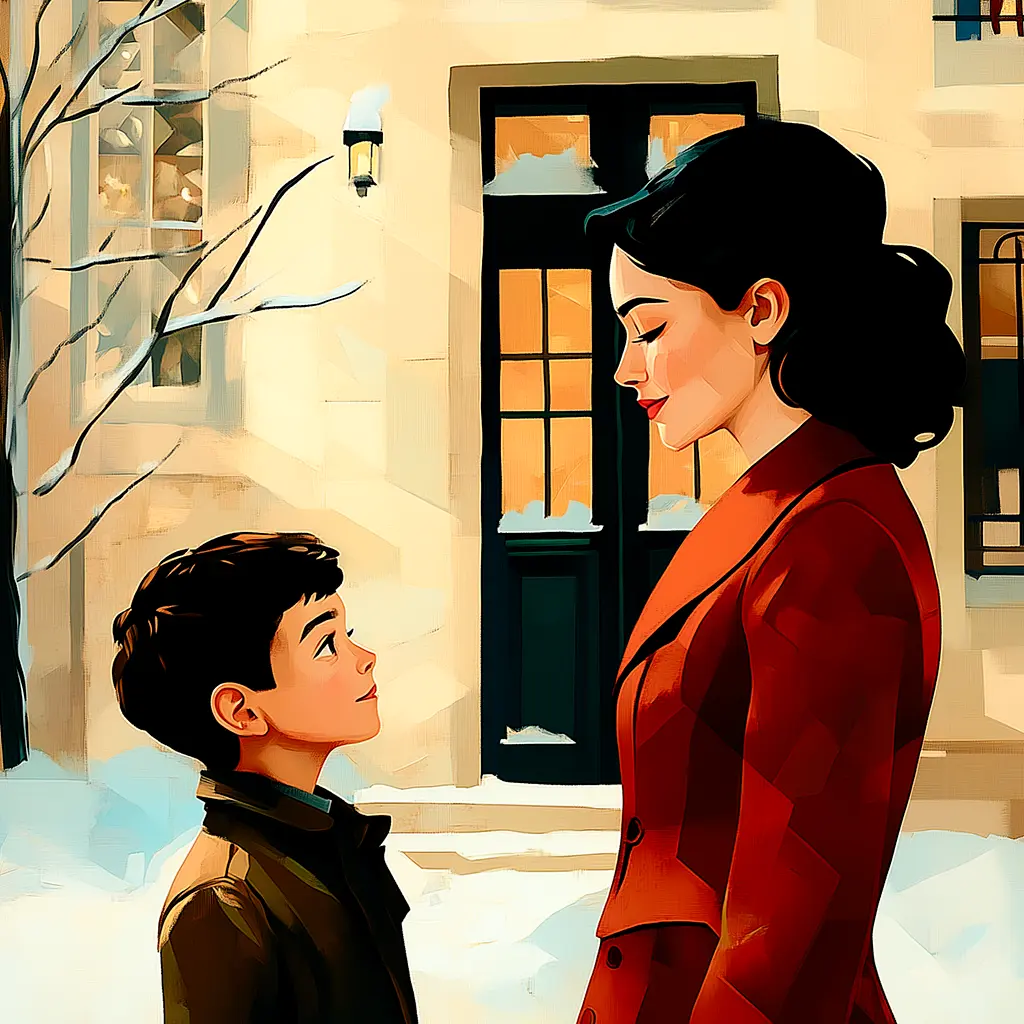
Michèle looked down over her armsful of boxes and plastic bags at a small boy in a loose tweed coat and tweed cap that hung over his ears. He had big dark eyes and an appealing smile. “Yes!” She managed to drop two francs which were still in her fingers after paying the taxi.
“Merci, madame!”
“And this,” said Michèle, suddenly remembering that she had stuck a ten-franc note into her coat pocket a moment ago.
The boy’s mouth fell open. “Oh, madame! Merci!”
One slippery shopping bag had fallen. The boy picked it up.
Michèle smiled, secured the bag handle with one finger, and pressed the door button with an elbow. The heavy door clicked open, and she stepped over a raised threshold. A shove of her shoulder closed the door, and she crossed the courtyard of her apartment house. Bamboo trees stood like slender sentinels on left and right, and laurels and ferns grew on either side of the cobbled path she took to Court E. Charles would be home, as it was nearly six. What would he say to all the packages, the more than three thousand francs she had spent today? Well, she had done most of their Christmas shopping, and one of the presents was for Charles to give his family—he could hardly complain about that—and the rest of the presents were for Charles himself and her parents, and only one thing was for her, a Hermés belt that she hadn’t been able to resist.
“Father Christmas!” Charles said as Michèle came in. “Or Mother Christmas?”
She had let the packages fall to the floor in the hall. “Whew! Yes, a good day! A lot done, I mean. Really!”
“So it seems.” Charles helped her to gather the boxes and bags.
Michèle had taken off her coat and slipped out of her shoes. They tossed the parcels on the big double bed in their bedroom, Michèle talking all the while. She told him about the pretty white tablecloth for his parents, and about the little boy downstairs who had asked her for a franc. “A franc—after all I bought today! Such a sweet little boy about ten years old. And so poor looking—his clothes. Just like the old stories about Christmas, I thought. You know? When someone with less asks for such a little bit.” Michèle was smiling broadly, happily.
Charles nodded. Michèle’s was a rich family. Charles Clement had worked his way up from apprentice mason at sixteen to become the head of his company, Athenas Construction, at twenty-eight. At thirty, he had met Michèle, the daughter of one of his clients, and married her. Sometimes Charles felt dazzled by his success in his work and in his marriage, because he adored Michèle and she was lovely. But he realized that he could more easily imagine himself as the small boy asking for a franc, which he would never have done, than he could imagine himself as Michèle’s brother, for instance, dispensing largesse with her particular attitude, at once superior and kindly. He had seen that attitude before in Michèle.
“Only one franc?” Charles said finally, smiling.
Michèle laughed. “No, I gave him a ten-franc note. I had it loose in my pocket—and after all it’s Christmas.”
Charles chuckled. “That little boy will be back.”
Michèle was facing her closet whose sliding doors she had opened. “What should I wear tonight? That light purple dress you like or—the yellow? The yellow one’s newer.”
Charles circled her waist with his arm. The row of dresses and blouses, long skirts, looked like a tangible rainbow: shimmering gold, velvety blue, beige and green, satin and silk. He could not even see the light purple in all of it, but he said, “The light purple, yes. Is that all right with you?”
“Of course, dear.”
They were going out to dinner at the apartment of some friends. Charles went back into the living room and resumed his newspaper, while Michèle showered and changed her clothes. Charles wore his house slippers—the habit of an old man, he thought, though he was only thirty-two. At any rate, it was a habit he had had since his teens, when he had been living with his parents in the Clichy area. Half the time he had come home with his shoes and socks damp from standing in mud or water on a construction lot, and woolen house slippers had felt good. Otherwise Charles was dressed for the evening in a dark blue suit, a shirt with cuff links, a silk tie knotted but not yet tightened at the collar. Charles lit his pipe—Michèle would be a long while yet—and surveyed his handsome living room, thinking of Christmas. Its first sign was the dark green wreath some thirty centimeters in diameter, which Michèle must have bought that morning, and which leaned against the fruit bowl on the dining table. Michèle would put it on the knocker of the apartment door, he knew. The brass fixtures by the fireplace gleamed as usual, poker and tongs, polished by Geneviève, their femme de ménage. Four of the six or seven oil paintings on the walls were of Michèle’s ancestors, two of them in white ruffled lace collars. Charles poured himself a small Glenfiddich whiskey, and sipped it straight. The best whiskey in the world, in his opinion. Yes, fate had been good to him. He had luxury and comfort, everywhere he looked. He stepped out of his clumsy house slippers and carried them into the bedroom, where he put on his shoes for the evening with the aid of a silver shoehorn. Michèle was still in the bathroom, humming, doing her make-up.
Two days later Michèle again encountered the small boy to whom she had given the ten-franc note. She was nearly at her house door before she saw him, because she had been concentrating on a white poodle that she had just bought. She had dismissed her taxi at the corner of the street, and was carefully leading the puppy on his new black and gold leash along the curb. The puppy did not know in which direction to go, unless Michèle tugged him. He turned in circles, scampered in the wrong direction until his collar checked him, then looked up smiling at Michèle and trotted after her. A man paused to look and admire.
“Not quite three months,” Michèle replied to his question.
It was then that she noticed the small boy. He wore the same tweed coat with its collar turned up against the cold, and she realized that it was a man’s suit jacket, much too big, with the cuffs rolled back and the buttons adjusted so it would fit more tightly around the child’s body.
“B’jour, madame!” the boy said. “This is your dog?”
“Yes, I’ve just bought him,” said Michèle.
“How much did he cost?”
Michèle laughed.
The boy whipped something out of his pocket. “I brought this for you.”
It was a tiny bunch of holly with red berries. As Michèle took it with her free hand, she realized that it was plastic, that the berries were bent on their artificial stems, the tinsel cup crushed. “Thank—you,” she said, amused. “Oh, and what do I owe you for this?”
“Nothing at all, madame!” He had an air of pride and looked her straight in the eyes, smiling. His nose was running.
She pressed the door button of her house. “Would you like to come up for a minute—play with the puppy?”
“Oui, merci!” he replied, pleased and surprised.
Michéle led the way across the court and into the lift. She unlocked her apartment door, and unfastened the puppy’s leash. Then she handed the boy a paper tissue from her handbag, and he blew his nose. The boy and the puppy behaved in the same manner, Michéle thought, looking around, turning in circles, sniffing.
“What shall I name the puppy?” Michèle asked. “Any ideas? What’s your name?”
“Paul, madame,” the boy replied, and returned to gazing at the walls, the big sofa.
“Let’s go in the kitchen. I’ll give you—a Coca-Cola.”
The boy and the puppy followed her. Michèle set down a bowl of water for the puppy, and took a bottle of Coca-Cola from the fridge.
The boy sipped his drink from a glass, while his eyes wandered over the big white kitchen, eyes that reminded Michèle of open windows, or of a camera’s lens. “You give the puppy biftek hâché, madame?” asked the boy.
Michèle was spooning the red meat from the butcher’s paper into a saucer. “Oh, today, yes. Maybe all the time, a little bit. Later he can eat from tins.” The child’s eyes had fixed on the meat she was wrapping up, and she said impulsively, “Would you like some? A hamburger?”
“Even uncooked! A little bit—yes.” He extended a hand whose nails were filthy, and took what Michèle held out in the teaspoon. Paul shoved the meat into his mouth.
Michèle put the meat package back into the fridge, and nudged the door shut. The boy’s hunger made her nervous, somehow. Of course if he were poor, his family wouldn’t eat meat often. She didn’t want to ask him about this. It was easier for her, a moment later, to offer Paul some cookies from a box that was nearly full. “Take several!” She handed the box to him.
Slowly and steadily, the boy ate them all, while he and Michèle watched the puppy licking the last morsels from his saucer. Then Paul picked up the saucer and carried it to the sink.
“Is this right, madame?”
Michèle nodded. She and Charles had a washing machine, and seldom used the sink for washing dishes. Now the boy was putting the empty cookie box into the yellow garbage bin. The bin was almost full, and the boy asked if he could empty it for her. Michèle shook her head a little, in wonderment, feeling as if a Christmas angel had wandered into her home. The boy and the white puppy! The boy so hungry, and he and the puppy so young! “It’s this way—but you don’t have to.”
The boy wanted to be of help, so she showed him the gray plastic sack at the servants’ entrance, where he could dump the contents of the garbage bin. Then they went back into the living room and played with the puppy on the carpet. Michèle had bought a blue rubber ball with a bell in it. Paul rolled the ball carefully for the puppy. He had politely declined to remove his coat or to sit down. Michèle noticed holes at the heels of both his socks. His shoes were in worse condition, cracked between soles and uppers. Even his blue jeans cuffs were tattered. How could a child keep warm in blue jeans in this weather?
“Thank you, madame,” said Paul. “I’ll go now.”
“Aw-ruff!” said the puppy, wanting the boy to roll the ball again.
Michèle found herself as awkward suddenly as if she were with an adult from a different country and culture. “Thank you for your visit, Paul. And I wish you a happy Christmas in case I don’t see you again.”
Paul looked equally ill at ease, twisted his neck, and said, “And to you, madame, happy Christmas.—And you!” He addressed the white puppy. Abruptly he turned towards the door.
“I’d like to give you a present, Paul,” Michèle said, following him. “How about a pair of shoes? What size do you wear?”
“Ha!” Was the boy blushing? “Thirty-two. Thirty-three maybe, since I’m growing, my father says.” He lifted one foot in a comical manner.
“What does your father do?” Michèle was delighted to ask him a down-to-earth question.
“Deliverer. He takes bottles down from trucks.”
Michèle imagined a sturdy fellow hauling down boxes of mineral water, wine, beer from a huge truck and tossing up empty crates. She saw such work all over Paris, every day, and maybe she had even glimpsed Paul’s father. “Have you brothers and sisters?”
“One brother. Two sisters.”
“And where do you live?”
“Oh—we live in a basement.”
Michèle didn’t want to ask him about the basement, whether it was a semi- or total basement, or whether his mother worked too. She was cheered by the idea of a present for him, shoes. “Come back tomorrow around eleven, and I’ll have a pair of shoes for you.”
Paul looked unbelieving, and wriggled his hands nervously in the pockets of his coat. “Yes, okay. At eleven.”
The boy wanted to go down in the lift by himself, so Michèle let him.
The next morning at a few minutes past eleven, Michèle was strolling along the pavement near her apartment with the puppy on his leash. She and Charles had decided to name him Ezekiel last evening, a name already shortened to Zeke. Michèle suddenly saw Paul and a smaller figure beside him.
“My sister, Marie-Jeanne,” said Paul, looking up at Michèle with his big dark eyes, then at his sister, whose hand he pushed towards Michèle.
Michèle took the little hand and they greeted each other. The sister was a smaller version of Paul, with longer black hair. The shoes. Michèle had bought two pairs for Paul. She asked them both to come up. The lift again, the apartment door opening, and the same wonder in the eyes of the sister.
“Try them on, Paul. Both pairs,” said Michèle.
Paul sat on the floor and did so, excited and happy. “They both fit! Both pairs!” For fun, he put on a left and a right shoe of different pairs.
Marie-Jeanne was taking more interest in the apartment than in the shoes.
Michèle fetched Coca-Cola. One bottle each might be enough, she thought. Her heart went out to these children, but she was afraid of overdoing it, of losing control somehow. When she brought the cold drinks in, Zeke was starting to chew on one new shoe, and Paul was laughing. Quickly his sister rescued the shoe. Some Coca-Cola got spilled on the carpet, Michèle brought a sponge, and Paul scrubbed away, then rinsed the sponge.
Then suddenly they were both gone, each with a box of shoes under an arm.
That evening Charles could not find his letter-opener. It lay always on his desk in a room off the living room which was their library as well as Charles’s study. He asked Michèle if she had possibly taken it.
“No. Maybe it fell on the floor?”
“I looked,” said Charles.
But they both looked again. It was of silver, like a flat dagger with the hilt in the form of a coiled serpent.
“Genevieve will find it somewhere,” said Michèle, but as soon as the words were out of her mouth, she suspected Paul—or even his sister. A throb went through her, akin to a sense of personal embarrassment, as if she were responsible for the theft, which was only a possibility, not yet a fact. But Michèle felt guilt as she glanced at her husband’s slightly troubled face. He was opening a letter with his thumbnail.
“What did you do today, darling?” asked Charles, smiling once more, putting his letter away in a business folder.
Michèle told him she had argued with the telephone company about their last bill and won, this on Charles’s behalf as he had queried a long-distance call, had looked in at the hairdresser’s but only for an hour, and had aired Zeke three times, and she thought the puppy was learning fast. She did not tell Charles about buying two pairs of shoes for the boy called Paul, or about the visit of Paul and his sister to the apartment.
“And I hung the wreath on the door,” said Michèle. “Not a lot of work, I know, but didn’t you notice?”
“Of course. How could I have missed it?” He embraced her and kissed her cheek. “Very pretty, darling, the wreath.”
That was Saturday. On Sunday Charles worked for a few hours in his office alone, as he often did. Michèle bought a small Christmas tree with an X-shaped base, and spent part of the afternoon decorating it, having put it on the dining table finally, instead of the floor, because the puppy refused to stop playing with the ornaments. Michèle did not look forward to the obligatory visit to Charles’s parents—who never had a tree, and even Charles considered Christmas trees a silly import from England—on Christmas Eve Monday at 5 P.M. They lived in a big old walk-up apartment house in the 18th arrondissement. Here they would exchange presents and drink hot red wine that always made Michèle feel sickish. The rest of the evening would be jollier at her parents’ apartment in Neuilly. They would have a cold midnight supper with champagne, and watch color TV of Christmas breaking all over the world. She told this to Zeke.
“Your first Christmas, Zeke! And you’ll have—a turkey leg!”
The puppy seemed to understand her, and galloped around the living room with a lolling tongue and mischievous black eyes. And Paul and Marie-Jeanne? Were they smiling now? Maybe Paul was, with his two pairs of shoes. And maybe there was time for her to buy a shirt, a blouse for Marie-Jeanne, a cake for the other brother and sister, before Christmas Day. She could do that Monday, and maybe she’d see Paul and be able to give him the presents. Christmas meant giving, sharing, communicating with friends and neighbors and even with strangers. With Paul, she had begun.
“Oo-woo-woo,” said the puppy, crouching.
“One second, Zeke, darling!” Michèle hurried to get his leash.
She flung on a fur jacket, and she and Zeke went out.
Zeke at once made for the gutter, and Michèle gave him a word of praise. The fancy grocery store across the street was open, and Michèle bought a box of candy—a beautiful tin box costing over a hundred francs—because the red ribbon on it had caught her eye.
“Madame—bonjour!”
Once more Michèle looked down at Paul’s upturned face. His nose was bright pink with cold.
“Happy Christmas again, madame!” Paul said, smiling, stamping his feet. He wore the brown pair of new shoes. His hands were rammed into his pockets.
“Would you like a hot chocolate?” Michèle asked. A bar-tabac was just a few meters distant.
“Non, merci.” Paul twisted his neck shyly.
“Or soup!” Michèle said with inspiration. “Come up with me!”
“My sister is with me.” Paul turned quickly, stiff with cold, and at that moment Marie-Jeanne dashed out of the bar-tabac.
“Ah, bonjour, madame!” Marie-Jeanne was grinning, carrying a blue straw shopping bag which looked empty, but she opened it to show her brother. “Two packs. That’s right?—Cigarettes for my father,” she said to Michèle.
“Would you like to come up for a few minutes and see my Christmas tree?” Michèle’s hospitality still glowed strongly. What was wrong with giving these two a bowl of hot soup and some candy?
They came. In the apartment, Michèle switched on the radio to London, which was giving out with carols. Just the thing! Marie-Jeanne squatted in front of the Christmas tree and chattered to her brother about the pretty packages amassed at the base, the decorations, the little presents perched in the branches. Michèle was heating a tin of split pea soup to which she had added an equal amount of milk. Good nourishing food! The English choirboys sang a French carol, and they all joined in:
Il est né le divin enfant . . .
Chantez hautbois, résonnez musettes . . .
Then as before they were gone all too suddenly—their laughter and chatter—Zeke barked as if to call them back, and Michèle was left with the empty soup bowls and crumpled chocolate papers to clear away. Impulsively Michèle had given them the pretty cookie box to take home. And Charles was due in a few minutes. Michèle had tidied the kitchen and was walking into the living room, when she heard the click of the lift door and Charles’s step in the hall, and at the same time noticed a gap on the mantel. The clock! Charles’s ormolu clock! It couldn’t be gone. But it was gone.
A key was fitted into the lock, and the door opened.
Michèle seized a box—yellow-wrapped, house slippers for Charles—and set it where the clock had been.
“Hello, darling!” Charles said, kissing her.
Charles wanted a cup of tea: the temperature was dropping and he had nearly caught a chill waiting for a taxi just now. Michèle made tea for both of them, and tried to seat herself so that Charles would take a chair that put his back to the fireplace, but this didn’t work, as Charles took a different armchair from the one Michèle had intended.
“What’s the idea of a present up there?” Charles asked, meaning the yellow package.
Charles had an eye for order. Smiling, still in a good mood, he left his first cup of tea and went to the mantel. He took the package, turned towards the Christmas tree, then looked back at the mantel. “And where’s the clock? You took it away?”
Michèle clenched her teeth, longing to lie, to say, yes, she’d put it in a cupboard in order to have room for Christmas decorations on the mantel, but would that make sense? “No, I—”
“Something the matter with the clock?” Charles’s face had grown serious, as if he were inquiring about the health of a member of the family whom he loved.
“I don’t know where it is,” Michèle said.
Charles’s brows came down and his body tensed. He tossed the lightweight package down on the table where the tree stood. “Did you see that boy again?—Did you invite him up?”
“Yes, Charles. Yes—I know I—”
“And today was perhaps the second time he was here?”
Michèle nodded. “Yes.”
“For God’s sake, Michèle! You know that’s where my letter-opener went too, don’t you? But the clock! My God, it’s one hell of a lot more important! Where does this kid live?”
“I don’t know.”
Charles made a move towards the telephone and stopped. “When was he here? This afternoon?”
“Yes, less than an hour ago. Charles, I really am sorry!”
“He can’t live far from here.—How could he have done it with you here with him?”
“His sister was here too.” Michèle had showed her where the bathroom was. Of course Paul had taken the clock, then, put it in that blue shopping bag.
Charles understood, and nodded grimly. “Well, they’ll have a nice Christmas, pawning that. And I’ll bet we won’t see either of them around here for the next many days—if ever. How could you bring such hoodlums into the house?”
Michèle hesitated, shocked by Charles’s wrath. It was wrath turned against her. “They were cold and they were hungry—and poor.” She looked her husband in the eyes.
“So was my father,” Charles said slowly, “when he acquired that clock.”
Michèle knew. The ormolu clock had been the Clement family’s pride and joy since Charles had been twelve or so. The clock had been the one handsome item in their working-class household. It had caught Michèle’s eye the first time she had visited the Clements, because the rest of the furnishings were dreadful style rustique, all varnish and formica. And Charles’s father had given the clock to them as a wedding present.
“Filthy swine,” Charles murmured, drawing on a cigarette, looking at the gap on the mantel. “You don’t know such people perhaps, my dear Michèle, but I do. I grew up with them.”
“Then you might be more sympathetic! If we can’t get the clock back, Charles, I’ll buy another for us, as near like it as possible. I can remember exactly how that clock looked.”
Charles shook his head, squeezed his eyes shut and turned away.
Michèle left the room, taking the tea things with her. It was the first time she had seen Charles near tears.
Charles did not want to go to the dinner party to which they were invited that evening. He suggested that Michèle go alone and make some excuse for him, and Michèle at first said she would stay at home too, then changed her mind and got dressed.
“I don’t see what’s the matter with my idea of buying another clock,” Michèle said. “I don’t see—”
“Maybe you’ll never see,” Charles said.
Michèle had known Bernard and Yvonne Petit a long time. Both had been friends of Michèle’s before she and Charles were married. Michèle wanted very much to tell Yvonne the story about the clock, but it was not a story one could tell at a dinner table of eight, and by coffee time Michèle had decided it was best not to tell it at all: Charles was seriously upset, and the mistake was her own. But Yvonne, as Michèle was leaving, asked her if something was on her mind, and Michèle was relieved to admit there was. She and Yvonne went into a library much like the one in Michèle’s apartment, and Michèle told the story quickly.
“We’ve got just the clock you need here!” said Yvonne. “Bernard doesn’t even much like it. Ha! That’s a terrible thing to say, isn’t it? But the clock’s right here, darling Michèle. Look!” Yvonne pushed aside some invitation cards, so that the clock on the library mantel showed plainly on its splayed base: black hands, its round face crowned with a tiara of gilded knobs and curlicues.
The clock was indeed very like the one that had been stolen. While Michèle hesitated, Yvonne found newspaper and a plastic bag in the kitchen and wrapped the clock securely. She pressed it into Michèle’s hands. “A Christmas present!”
“But it’s the principle of the thing. I know Charles. So do you, Yvonne. If the clock that was stolen were from my family, if I’d known it all my life, even, I know it wouldn’t matter to me so much.”
“I know, I know.”
“It’s the fact that these kids were poor—and that it’s Christmas. I asked them in, Paul first, by himself. Just to see their faces light up was so wonderful for me. They were so grateful for a bowl of soup. Paul told me they live in a basement somewhere.”
Yvonne listened, though it was the second time Michèle had told her all this. “Just put the clock on the mantel where the clock was—and hope for the best.” Yvonne spoke with a confident smile.
When Michèle got home by taxi, Charles was in bed reading. Michèle unwrapped the clock in the kitchen and set it on the mantel. Amazing how much it did look like the other clock! Charles, behind his newspaper, said that he had taken Zeke out for a walk half an hour ago. Otherwise Charles was silent, and Michèle did not try to talk to him.
The next morning, Christmas Eve, Charles spotted the new clock on the mantel as he walked into the living room from the kitchen, where he and Michèle had just breakfasted. Charles turned to Michèle with a shocked look in his eyes. “All right, Michèle. That’s enough.”
“Yvonne gave it to me. To us. I thought—just for Christmas—” What had she thought? How had she meant to finish that sentence?
“You do not understand,” he said firmly. “I gave the police a description of that clock last night. I went to the police station, and I intend to get that clock back! I also informed them of the boy aged ‘about ten’ and his sister who live somewhere in the neighborhood in a basement.”
Charles spoke as if he had declared war on a formidable enemy. To Michèle it was absurd. Then as Charles talked on in his tone of barely repressed fury about dishonesty, handouts to the irresponsible, to those who had not earned them or even tried to, about hooligans’ disrespect for private property, Michèle began to understand. Charles felt that his castle had been invaded, that the enemy had been admitted by his own wife—and that she was on their side. Are you a Communist, Charles might have asked, but he didn’t. Michèle didn’t consider herself a Communist, never had.
“I simply think the rich ought to share,” she interrupted.
“Since when are we rich, really rich, I mean?” Charles replied. “Well, I know. Your family, they are rich and you’re used to it. You inherited it. That’s not your fault.”
Why on earth should it be her fault, Michèle wondered, and began to feel on surer ground. She had read often enough in newspapers and books that wealth had to be shared in this century, or else. “Well—and as for these kids, I’d do the same thing again,” she said.
Charles’s cheeks shook with exasperation. “They insulted us! This was thievery!”
Michèle’s face grew warm. She left the room, as furious as Charles. But Michèle felt that she had a point. More than that, that she was right. She should put it into words, organize her argument. Her heart was beating fast. She glanced at the open bedroom door, expecting Charles’s figure, expecting his voice, asking her to come back. There was silence.
Charles went off to his office half an hour later, and said he would probably not be back before 3:30. They were to go to his parents’ house between four and five. Michèle rang up Yvonne, and in the course of their conversation Michèle’s thoughts became clearer, and her trickle of tears stopped.
“I think Charles’s attitude is wrong,” Michèle said.
“But you mustn’t say that to a man, dear Michèle. You be careful.”
That afternoon at four, Michèle began tactfully with Charles. She asked him if he liked the wrapping of the present for his mother. The package contained the white tablecloth, which she had shown Charles.
“I’m not going. I can’t.” He went on, over Michèle’s protestations. “Do you think I can face my parents—admit to them that the clock’s been stolen?”
Why mention the clock, unless he wanted to ruin Christmas, Michèle thought. She knew it was useless to try to persuade him to come, so she gave it up. “I’ll go—and take their presents.” So she did, and left Charles at home to sulk, and to wait for a possible telephone call from the police, he had said.
Michèle had gone out laden with Charles’s parents’ presents as well as those for her own parents. Charles had said he would turn up at her parents’ Neuilly apartment at 8 P.M. or so. But he did not. Michèle’s parents suggested that she telephone Charles: maybe he had fallen asleep, or was working and had lost track of time, but Michèle did not telephone him. Everything was so cheerful and beautiful at her parents’ house—their tree, the champagne buckets, her nice presents, one a travel umbrella in a leather case. Charles and the clock story loomed like an ugly black shadow in the golden glow of her parents’ living room, and Michèle again blurted out the events.
Her father chuckled. “I remember that clock—I think. Nothing so great about it. It wasn’t made by Cellini after all.”
“It’s the sentiment, however, Edouard,” said Michèle’s mother. “A pity it had to happen just at Christmas. And it was careless of you, Michèle. But—I have to agree with you, yes, they were simply little urchins of the street, and they were tempted.”
Michèle felt further strengthened.
“Not the end of the world,” Edouard murmured, pouring more champagne.
Michèle remembered her father’s words the next day, Christmas Day, and on the day after. It was not the end of the world, but the end of something. The police had not found the clock, but Charles believed they would. He had spoken to them with some determination, he assured Michèle, and had brought them a colored drawing of the clock which Charles had made at the age of fourteen.
“Naturally the thieves wouldn’t pawn it so soon,” Charles said to Michèle, “but they’re not going to drop it in the Seine either. They’ll try to get cash for it sooner or later, and then we’ll nail them.”
“Frankly, I find your attitude unchristian and even cruel,” said Michèle.
“And I find your attitude—silly.”
It was not the end of the world, but it was the end of their marriage. No later words, no embrace if it ever came, could compensate Michèle for that remark from her husband. And, just as vital, she felt a deep dislike, a real aversion to her within Charles’s heart and mind. And she for him? Was it not a similar feeling? Charles had lost something that Michèle considered human—if he had ever had it. With his poorer, less privileged background, Charles should have had more compassion than she, Michèle thought. What was wrong? And what was right? She felt muddled, as she sometimes did when she tried to ponder the phrases of carols, or of some poems, which could be interpreted in a couple of ways, and yet the heart, or sentiment always seemed to seek and find a path of its own, as hers had done, and wasn’t this right? Wasn’t it right to be forgiving, especially at this time of year?
Their friends, their parents counseled patience. They should separate for a week or so. Christmas always made people nervous. Michèle could come and stay at Yvonne’s and Bernard’s apartment, which she did. Then she and Charles could talk again, which they did. But nothing really changed, not at all.
Michèle and Charles were divorced within four months. And the police never found the clock.
THE END