Plot: Edwin is a thirteen-year-old boy who has spent his entire life confined within a vast mansion. His mother has taught him that the outside world is inhabited by deadly “Beasts” that killed his father, and that leaving the house is tantamount to dying. The house functions as a complete universe divided into territories Edwin crosses daily to attend school, where he is taught by a mysterious teacher who wears a hooded robe and glasses, so that her face cannot be seen. One day, Edwin discovers an open door that leads to a tower from which he sees the outside world for the first time. Shortly afterward, after celebrating his birthday, he finds his mother unconscious in the Parlor. He looks for his teacher, but all he finds is her robe, her glasses, and her makeup. With no one to stop him, Edwin goes through the garden, crosses the iron gate, and steps into the real world, shouting with joy that he is dead—since that is the only word he knows to describe the outside.
Summary of “Jack-in-the-Box,” by Ray Bradbury
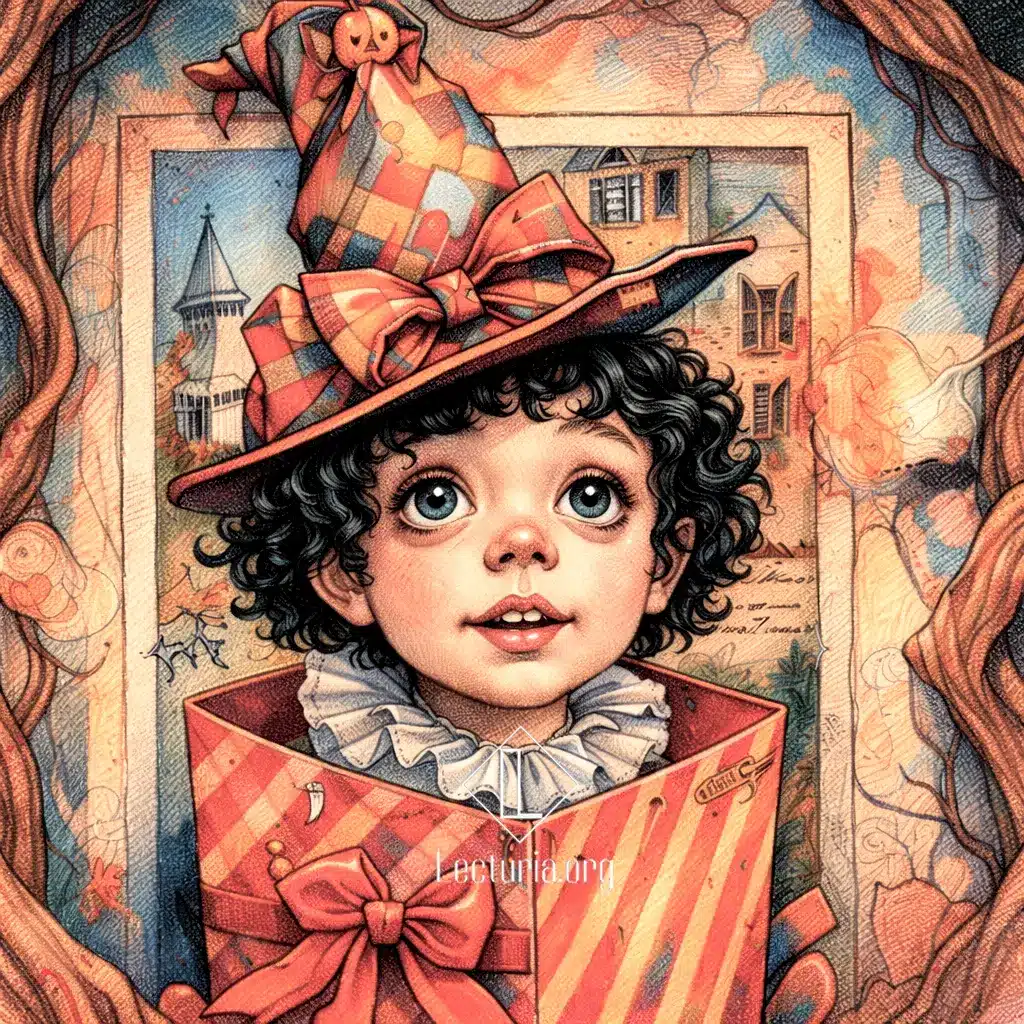
“Jack-in-the-Box,” a short story by Ray Bradbury published in 1947 in the book Dark Carnival, tells the story of Edwin, a thirteen-year-old boy who has lived his entire existence confined in an enormous mansion isolated from the outside world. His mother has raised him in a closed universe where she has taught him that beyond the trees surrounding the house there is only death, populated by monstrous “Beasts” who one day killed his father.
The story begins with Edwin holding a jack-in-the-box whose rusted lid refuses to open. The figure remains trapped inside, compressed. The boy abandons the toy and looks out the window at the trees surrounding the house, wondering what lies beyond. His mother calls him to breakfast in a nervous voice. When Edwin murmurs that he prefers the window, she erupts in a fit of rage and asks whether he wants to see the Beasts who crush people, whether he wants to go out like his father and be murdered by the Terrors of the road. She reminds him that his father built that World for him and that there is nothing beyond the trees except death.
The mansion is presented as a miniature cosmos divided into “Worlds”: the Lowlands comprise the kitchen, dining room, and Parlor; the Middle Countries contain music rooms and forbidden chambers; the Highlands are the territory of learning, where the school is located. The dead father, whom the mother calls “God,” erected this universe where the stars light up with a switch and the sun is the mother.
As he climbs the stairs toward school, Edwin discovers that one of the forbidden doors is open. A spiral staircase rises into the unknown. Trembling, he climbs step by step until he reaches a tower flooded with sunlight. For the first time he is above the barrier of trees and he gazes upon green grass, trees, and white ribbons along which beetles run, and the other half of the world is blue and infinite. He grows dizzy, vomits, and stumbles down, convinced he will go blind for having seen what was forbidden. But minutes later he realizes he can still see, and he has discovered that the universe does not end with the forest.
Edwin arrives late to school, where he is greeted by Teacher, a figure wrapped in a gray hooded robe that hides her face, gray gloves, and silver glasses. When the boy confesses that he saw the outside world, Teacher slumps into her chair with a numb voice. She asks whether the mother is too demanding, whether she suffocates him. Edwin sobs that yes, she does. Teacher writes a note for him to give his mother, asking her to grant the boy two free hours each afternoon. At that moment, the light from the fire illuminates the face beneath the hood and Edwin catches his breath: Teacher looks like his mother. The woman reacts sharply, insisting that all women look alike.
That afternoon, the mother announces that the next day they will celebrate Edwin’s birthday, although only ten months have passed since the previous one. Each birthday a new secret room is opened until the age of twenty-one, when Edwin will become the Man of the House. That night, thinking about how to free the trapped figure, Edwin throws the box out the window. The toy smashes against the pavement and the Jack lies sprawled with arms outstretched in a gesture of freedom.
The next day mother and son hold a frantic party and open the fourteenth door, which turns out to be a small closet. The mother pushes Edwin inside and presses a red button. The room trembles and rises, instantly carrying them to the Highlands: it is a secret elevator. They spend the afternoon in the garden, where the mother startles at the sound of Monsters roaring beyond the forest, and they see a chrome bird fly, roaring, among the trees. At night, while the boy lies in his room thinking over what happened during the day, he hears glass breaking in the vestibule, which makes him think of his mother and what would happen if something happened to her.
The next morning, Edwin wakes in a house sunk in silence. He finds his mother collapsed in the Parlor in her party dress, the floor covered with broken crystals. There is no food on the table. Her hands are cold and she does not respond. Edwin runs up to the schoolroom, but it is empty. On the desk he finds the gray robe neatly folded, the silver glasses, and a single gray glove. There is also a makeup pencil. A door that is always closed now opens onto a closet with a red button. Edwin presses it, descends, and emerges into the Parlor through an oak panel. When he turns his unconscious mother over, he finds beneath her the missing gray glove.
Edwin sits for a long time holding the glove, whimpering. He waits for hours, but no one comes to wake the motionless woman. He concludes that Teacher must have gotten lost in the Outlands and that he must go out to look for her. He goes into the garden and sees the shattered box with the Jack lying there, its arms open toward the forbidden path. At last he passes beyond the garden wall and walks down the road calling for Teacher. When he turns around, he discovers that his World has shrunk. Everything in front of him is new: smells, colors, incredible shapes. He thinks that if he runs beyond the trees he will die, but he wonders what dying is. Another room larger than all the ones that ever existed? He sees an iron gate half open and beyond it a room as big as the sky. He runs, trips, falls, gets up, passes through the gate; the Universe shrinks behind him as his old Worlds fade away.
A policeman standing on the sidewalk remarks to a passerby that a boy has just run past laughing and crying at the same time, jumping and touching everything: lampposts, fire hydrants, dogs, people, sidewalks, cars. The passerby asks what he was shouting. The policeman answers that he kept repeating: “I’m dead, I’m dead, I’m glad I’m dead, it’s good to be dead!” The policeman scratches his chin and concludes that it must be one of those new children’s games.
Analysis of “Jack-in-the-Box,” by Ray Bradbury
“Jack-in-the-Box” belongs to the first stage of Ray Bradbury’s output, when the author was still exploring the territories of horror and the macabre before consolidating himself as a central figure in science fiction. Published in 1947 in the collection Dark Carnival, the story inscribes itself in a Gothic tradition that Bradbury reshapes with his particular sensibility: instead of European castles and decadent aristocracies, he situates horror at the heart of the American family, in a mansion that could exist in any suburb. The story of Edwin, a boy raised in total isolation by a mother who has made him believe the outside world is populated by lethal monsters, works as an exploration of the psychological effects of confinement and sustained deception. Bradbury constructs a narrative that operates on several levels simultaneously: it is a horror story about a stolen childhood, a fable about the dangers of possessive love, and a coming-of-age tale in which the protagonist must literally break with his world in order to be born into another. The English title, “Jack-in-the-Box,” alludes to the toy known in Spanish as caja de sorpresas, the mechanism in which a figure remains compressed until someone opens the lid and releases it. This image runs through the entire story and gives it its fundamental symbolic structure.
The story sets up an extreme situation that functions like a laboratory for examining the consequences of parental overprotection taken to its absolute limit. Edwin’s mother is not an evil character in the traditional sense; she is a terrified woman who, after losing her husband in what was probably a traffic accident, decides that the only way to protect her son is to eliminate the outside world entirely from his existence. What makes this story disturbing is not the mother’s cruelty but her love. Every lie, every closed door, every story about the “Beasts” is born from a genuine desire to keep Edwin safe. Bradbury thus forces us to contemplate how love, when mixed with fear and absolute control, can become a prison.
Bradbury turns the mansion into a complete cosmology. It is not simply a big house, but a universe with its own sacred geography: the Lowlands, the Middle Countries, and the Highlands function as strata of reality that Edwin must traverse daily. The dead father occupies the place of a creator God, the mother is the sun around which everything revolves, and Edwin is a small meteor in orbit. This structure is not decorative; it reveals how children build their understanding of the world from what adults provide them. If a child is told that his house is the entire universe, he will organize his mind around that premise. Stairs become interplanetary journeys, rooms become continents, and closed doors become the edges of the known cosmos.
The jack-in-the-box appears at the beginning and reappears near the end, framing the narrative with its presence. The figure trapped inside, unable to spring because the rusted lid won’t open, is Edwin. Bradbury establishes this equivalence from the first page: the boy feels the contained pressure of the toy as if it were a heart beating against his hands. When Edwin finally throws the box out the window and it breaks, the Jack lies there with arms open in a gesture of freedom. This moment anticipates and prefigures Edwin’s own liberation. The broken toy, with its ambiguous smile that appears and disappears depending on the sunlight, points toward the forbidden path like a silent invitation. Bradbury uses this object to condense the entire story’s argument into one image: freedom requires rupture, and rupture implies destruction of the container that held us.
One of the most unsettling elements of the story is the revelation (intended for the reader but not necessarily for the protagonist) that Teacher and the mother are the same person. Bradbury plants clues throughout the text: Teacher has never known the mother, disappears at night without explanation, and when the firelight illuminates her face, Edwin recognizes maternal features even as Teacher discourages him by saying all women look alike. The mother has created a double of herself to give Edwin the illusion of a social world, of formal schooling, of an authority figure distinct from her. This detail reveals the magnitude of her madness and her devotion. For years she has played two roles, has ridden the secret elevator up and down to appear as two different women, has maintained an exhausting farce. When Edwin discovers the robe, the glasses, and the glove beside his unconscious mother, the reader connects the dots the boy does not seem to connect: his entire universe has been a theater with a single actress. Edwin, by contrast, simply concludes that Teacher has gotten lost in the Outlands and goes out to search for her.
Throughout the story, Edwin repeatedly asks what it means to die. His mother has told him that his father died, that the Beasts kill, that leaving the house is equivalent to death. But these words have no real content for the boy because he has never experienced anything outside his closed world. Death is only a sound, an abstract threat. That is why the ending is so revealing: when Edwin passes through the gate and steps into the outside world, he shouts that he is dead, that he is glad to be dead, that it is good to be dead. For him, “to die” simply means “to go outside.” He has taken the only word his mother gave him to describe the exterior and adopted it with joy. The policeman who watches the boy cannot understand what he sees because he lacks the context. To any external observer, Edwin looks like a child playing. Only the reader understands that he is witnessing a birth disguised in the vocabulary of death.
Bradbury writes this story in a language that hovers between prose and poetry. Descriptions of the house are not functional but evocative: corridors are dark galleries where light falls like white waterfalls, Persian carpets become crimson meadows, dust descends in showers of sparks. This lyrical treatment of space transforms the mansion into a dark fairy-tale place, closer to the enchanted castles of the Gothic tradition than to a real residence. The choice is not accidental: Bradbury needs the reader to feel the house as Edwin feels it, as a place magical and terrible at once, where every room contains mysteries and every closed door promises revelations.
The books in Edwin’s library have been mutilated: pages torn out, lines erased, images cut away, volumes sealed with bronze straps. The mother has created a censored version of all human knowledge, removing any reference that might reveal the existence of the outside world. This detail expands the story’s scope beyond the mother-son relationship. Bradbury gestures toward every form of education that operates through subtraction, that “protects” the young by hiding information from them instead of preparing them to face it. The irony is that such censorship cannot be perfect: one door left open, one momentary oversight, is enough for the entire edifice of lies to begin to collapse.
The story’s climax occurs when Edwin, after discovering that his mother lies unconscious and that Teacher has disappeared, must make a choice. He could stay in the house waiting for the mother to wake. Instead, he goes into the garden, sees the broken box with the freed Jack, and follows the forbidden path. Bradbury builds this sequence with precision: the boy clings first to the garden wall, then crosses it, moves forward calling for Teacher (without realizing she never existed as an independent person), and finally runs toward the gate. When Edwin looks back and sees that his house has shrunk, that the entire universe of his childhood now fits into a tiny space, he experiences the revelation all children eventually face: the parents’ world is not the whole world.
“Jack-in-the-Box” functions simultaneously as a tale of psychological horror, as a fable about parental overprotection, and as a coming-of-age story. Bradbury offers neither easy answers nor simple condemnations. The mother is not a monster but a woman shattered by fear. Edwin is not a passive victim but a child whose curiosity proves stronger than thirteen years of indoctrination. The outside world is neither the paradise nor the hell each imagined, but simply the world: vast, indifferent, full of lampposts and sidewalks and dogs a child can touch while laughing and crying at the same time. What Bradbury leaves us with is an uncomfortable question about the limits of care, about when protection becomes a cage, and about the inevitable moment when every human being must break the box that contains them to discover whether outside there is death or life—or perhaps both at once.