Synopsis: In the abandoned library of the Fitero Abbey, a visitor discovers among the dust an old music notebook: an unfinished Miserere, covered with strange annotations in German that seem written by a madman and that speak of creaking bones and howling strings. Intrigued by the find, he asks an old man from the area for an explanation, who recounts an ancient legend. Years earlier, on a stormy night, a pilgrim musician arrived at the abbey, tormented by a guilt from his youth, determined to compose a song of repentance so sublime that it would earn him divine forgiveness. When one of the shepherds gathered around the fire tells him of the Miserere of the Mountain—a supernatural music that, according to the tale, is heard every Holy Thursday in the ruins of a monastery burned down centuries ago—the pilgrim decides to venture that very night into the crags to hear it.
Warning
The following summary and analysis is only a semblance and one of the many possible readings of the text. It is not intended to replace the experience of reading the story.
Summary of The Miserere by Gustavo Adolfo Bécquer
“The Miserere” (El miserere) is a legend by Gustavo Adolfo Bécquer published on April 17, 1862 in the Madrid newspaper El Contemporáneo, and later collected among the pieces that make up his Legends. The story recounts the chance discovery, in the library of Fitero Abbey, of an old unfinished music notebook containing unsettling annotations in German; from this discovery, an old man tells the narrator the story of a pilgrim musician who, consumed by guilt over an ancient crime, seeks to compose a Miserere capable of obtaining divine forgiveness, and who, after witnessing a supernatural apparition in the ruins of a burned monastery, loses his mind without being able to complete the work.
The story opens with a first-person narrator who, during a visit to the famous Fitero Abbey, amuses himself rummaging through the abandoned volumes in its library. Among the dust and mouse-gnawed paper, he discovers two or three old music notebooks: it is a Miserere. Although he admits to knowing nothing about music, his fondness for it leads him to leaf through the pages. He soon notices two oddities: on the last page appears the word finis, yet the composition only reaches the tenth verse; and instead of the customary Italian musical markings, the staff is covered with lines written in German. These notes are disturbing: they speak of bones that creak, of strings that howl without being out of tune, of metals that thunder without deafening, and they conclude with a recommendation that seems delirious: “The notes are bones covered with flesh; inextinguishable fire, the heavens and their harmony… strength!… strength and sweetness.” Bewildered, the narrator questions an old man accompanying him, and the old man recounts the legend that forms the core of the story.
Many years earlier, on a rainy and stormy night, a pilgrim arrives at the cloister gate of the abbey asking for fire, bread, and shelter. The lay brother attends to him, and by the warmth of the hearth asks about his trade and the purpose of his pilgrimage. The stranger reveals himself to be a musician and confesses that in his youth he used his art as a weapon of seduction, kindling passions that drove him to a crime. Now older, he seeks to redeem himself by the same path through which he may have been damned. Having chanced to open a holy book, he came upon the psalm of David Miserere mei, Deus (Have mercy on me, God!), and since then has lived with a single obsession: to find a musical form so sublime that it can fittingly contain that hymn of pain—a Miserere so harrowing that the very archangels weep upon hearing it and beg with it for the Lord’s mercy. He recounts that he has traveled through Germany, Italy, and much of Spain listening to every religious composition in existence, without any of them serving as inspiration.
One of the farmhands, who is listening to the conversation around the fire, interrupts to ask whether he has heard the Miserere of the Mountain. To the musician’s surprise, the shepherd recounts its history: in the most rugged part of the nearby mountain ranges, there existed centuries ago a monastery built by a lord with the inheritance that was to pass to his son; as punishment for his misdeeds, the father disinherited him upon death. The son, having gathered a band of outlaws, returned one Holy Thursday night, at the very moment the monks were beginning the Miserere in the choir, and set fire to the monastery, sacked the church, and hurled them all over a cliff over which a waterfall plunges. Since then, every year on that same night, lights are seen through the broken windows of the ruined church and a strange music is heard: they are the monks, who died in sin, returning from purgatory to implore mercy by singing the psalm. The farmhand specifies that there are barely three hours until the wonder repeats itself, for that night is Holy Thursday, and the place is no more than a league and a half away.
Ignoring the protests of those present, who consider him abandoned by God, the pilgrim takes his staff and vanishes into the stormy night. After one or two hours of walking, following the course of a stream, he reaches the dark and imposing ruins of the monastery. The rain has stopped, and the wind draws moans from the deserted cloisters, but to the pilgrim, hardened by countless ordeals, none of it seems supernatural. He sits on the mutilated statue of a tomb and waits. The dripping of water through the cracks, the cry of an owl sheltering beneath the stone nimbus of a statue, the rustling of reptiles among the weeds and gravestones—all sounds rhythmic, yet nothing happens. He begins to believe he has been deceived, when suddenly he hears a new sound, like the mechanism of a clock about to strike the hour: eleven chimes sound, although in the crumbled temple there is no bell, no clock, no tower.
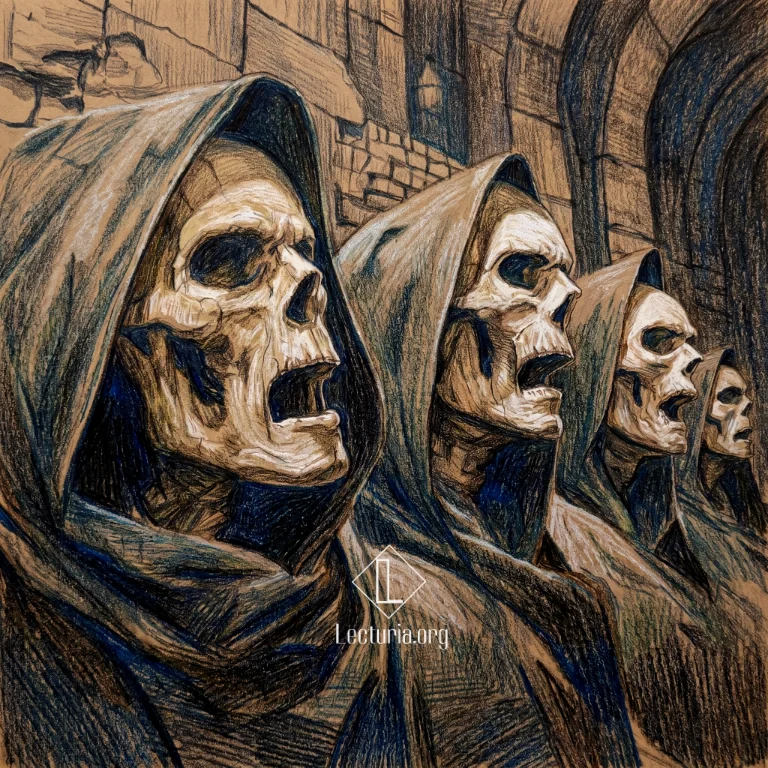
Barely has the last vibration faded when the entire church begins to glow without any visible source, with a bluish and phosphorescent light, like that emitted by skeletons in the dark. Stones join with stones, the altar is restored intact, the fallen chapels rise again, the broken capitals regain their shape, and the arches re-link to form a labyrinth of porphyry. Once the temple is rebuilt, a distant chord is heard, seeming to rise from the bowels of the earth. Seized between fear and fascination, the musician leans over the abyss where the torrent plunges and watches as, from the depths of the waters, emerge the skeletons of the monks cast down centuries before. Wrapped in the tatters of their habits, with their cowls pulled down over their skulls, they climb the crags with bony fingers while intoning in a sepulchral voice the first verse of the psalm: Miserere mei, Deus, secundum magnam misericordiam tuam (Have mercy on me, God, according to your great mercy!).
The monks advance in two rows to the choir and there continue their singing. The music that accompanies them is made of distant thunder, of the humming of air in the hollow of the mountain, of the monotonous sound of the waterfall, of the drop that seeps through, of the cry of the owl and the rustling of the reptiles, and of something more, inexplicable, akin to the echo of a gigantic organ. Upon pronouncing the verse In iniquitatibus conceptus sum: et in peccatis concepit me mater mea (“In iniquity I was conceived, and in sins my mother conceived me”), a tremendous shriek resounds in the vaults, like a cry of pain wrung from all of humanity, made of laments, howls, and blasphemies. Then, after a sudden transformation, the church is bathed in heavenly light, the bones are clothed in flesh, a halo shines around the brows, the dome breaks open, and the sky opens like an ocean of radiance. Seraphim, archangels, and angels accompany with a hymn of glory the verse Auditui meo dabis gaudium et laetitiam: et exultabunt ossa humiliata (“You will make me hear joy and gladness, and the humbled bones shall rejoice”), which rises to the Lord’s throne like a spiral of sonorous incense. At that instant, the dazzling radiance blinds the pilgrim, his ears ring, and he falls senseless to the ground.
The next day, the pilgrim reappears at the abbey, pale and beside himself. The lay brother, with a certain irony, asks whether he has finally heard the Miserere; the musician replies in the affirmative and begs the abbot for shelter and bread for a few months, promising in return to leave him an immortal work that will efface his sins before God and perpetuate the memory of the monastery. The monks, out of curiosity, advise accepting; the abbot, out of compassion, and even considering him mad, consents. Once settled there, the musician works night and day with feverish intensity: he pauses, listens to something in his imagination, exclaims that it is so, and continues writing notes at great speed. He manages to compose the first verses and advances to the midpoint of the psalm, but upon reaching the last verse he heard on the mountain, he cannot go on. He drafts one, two, a hundred, two hundred attempts: all in vain. His music bears no resemblance to what he has already noted down. Sleep abandons him, he loses his appetite, fever overtakes him, and he ends up losing his mind and dying without completing the work. The friars preserve the manuscript as a curiosity, and there it remains in the archive of the abbey.
When the old man concludes the tale, the narrator looks again at the manuscript open on the table. On the page before him he reads the words In peccatis concepit me mater mea (“In sins my mother conceived me”), which seem to mock him with their indecipherable notes and signs. He confesses that he would give the world to be able to read them, and wonders, in the final line of the story, whether perhaps all of it might not be madness.
Literary Analysis of The Miserere by Gustavo Adolfo Bécquer
“The Miserere” belongs to the collection of Legends that Gustavo Adolfo Bécquer was publishing in the Madrid press at the beginning of the 1860s, and may be considered one of the most representative pieces of Spanish late Romanticism. Bécquer writes at a moment when the European Romantic movement has already borne its greatest fruits and is beginning to yield ground to Realism, yet he reworks its motifs—the supernatural, guilt, art as absolute aspiration, the medieval ruin—with a new sensibility, more restrained and more lyrical. The story operates simultaneously on several levels: as a ghost story set in a monastic and nocturnal Spain, as a parable about the limits of human art before the divine, and as a meditation on the madness that haunts those who pursue an impossible beauty. Its symbolic structure rests on a central opposition between the finite and the infinite: the musician aspires to capture in notes a pain and a mercy that, by definition, surpass him.
The subtitle “religious legend” accompanying the text orients the reader from the outset about the subgenre to which it belongs. We are not before a fantastic tale in the manner of Hoffmann, nor before a simple pious story: the Becquerian legend is situated in an intermediate terrain in which the marvelous appears legitimized by popular tradition and by the Christian framework. Within this subgenre we could also include other pieces by the author such as “The Spirits’ Mountain” or “Master Pérez the Organist,” with which “The Miserere” shares certain features: the monastic setting, the appointed night of the liturgical calendar, music as a vehicle between the world of the living and that of the dead. The story also absorbs elements of the Gothic novel (the ruins, the storm, the skeletons rising from the waters, the monastery burned by a prodigal son turned outlaw) and of the Romantic artist tale, that subgenre in which a creator aspires to the absolute and pays for his audacity with his reason or his life.
The narrative structure is particularly carefully crafted and follows a Chinese-box scheme. There is an initial frame, in first person, in which the narrator discovers the manuscript in Fitero and asks the old man for an explanation; an intermediate account, in which the old man recounts the pilgrim’s arrival at the abbey and conveys, within this second voice, the shepherd’s story about the mountain monastery; an autonomous core, Chapter II, devoted to the nocturnal vision; and a denouement, Chapter III, which closes the musician’s fate. The story then returns to the initial frame to conclude the scene with the narrator’s gaze upon the manuscript and the final question. This layered arrangement has a precise function: by distancing the supernatural episode through several intermediate narrators, Bécquer creates a zone of uncertainty that shields the story from the disbelief of the modern reader and, at the same time, suggests that the truth of what occurred is always one step away, as unattainable as the score itself.
The central character, the pilgrim musician, has no proper name and no specific nationality, although his annotations in German and his journey through Germany, Italy, and Spain situate him in the tradition of the wandering European artist. His motivation is twofold and paradoxical: he wants to use the very same art with which he sinned—the musical seduction that led him to crime—to obtain salvation. He is, therefore, a character caught between pride and repentance, between the will to create something unrepeatable and humility before the psalm of David. In this sense he resembles other Romantic creators obsessed with the absolute work, but Bécquer adds a specific theological dimension: he does not seek artistic glory in itself, but rather wishes the archangels to weep upon hearing him and beg with him for the Lord’s mercy. The other characters are functional: the lay brother offers monastic hospitality and represents common sense; the farmhand acts as transmitter of oral tradition; the old man in the library fulfills the role of living archive of Fitero’s memory; and the skeletal monks are collective rather than individual figures, a choral image of humanity imploring forgiveness.
The setting contributes decisively to the effect of the story. Fitero Abbey, located in Navarre, is a real place that Bécquer had visited during his convalescence, and its introduction into the narrative anchors the story in a verifiable geography. From that firm starting point, the reader is led toward a second, progressively more unreal space: the ruined monastery in the mountains, the cliff with its waterfall, the cloister inhabited by reptiles and owls. The landscape, laden with weeds, funerary slabs, and mutilated statues, partakes of an aesthetic of ruins very dear to Romanticism, but Bécquer works it with an almost painterly descriptive precision. The time of year—Holy Thursday—is not accidental: it coincides with the traditional liturgy of the Miserere in the Tenebrae services, and allows the supernatural to occur on a date when Catholic liturgy itself stages death and the expectation of resurrection.
The narrative voice deserves a separate observation. The frame narrator is a learned subject but of modest and slightly humorous tone, who shows himself aware of the limits of his own knowledge and ends by yielding to doubt: “Who knows if it might not all be madness?” That question, far from being an ornamental device, constitutes the interpretive key to the entire story: the text simultaneously offers two incompatible readings—the vision was real, the vision was the delirium of an obsessed man—and does not choose between them. The secondary narrator, the old man, acts as vicarious witness and legitimizes the legend through the channel of tradition; the omniscient narrator of the central episode, by contrast, assumes the pilgrim’s viewpoint and minutely describes concrete physical sensations (the cold in the marrow, the chattering teeth, the throbbing temples), which intensifies the impression of reality of the wonder.
The themes the story develops are multiple and intertwined. The first is guilt and the possibility of repentance: the musician is a criminal who attempts to rescue his soul through beauty, and Psalm 50—the Miserere attributed to David after his adultery with Bathsheba—embodies in an exemplary way that voice of the sinner crying out for mercy. The second is the insufficiency of human art before the divine: the protagonist is capable of hearing the music of the dead, but not of transcribing it in its entirety; half the psalm is noted down, the other half remains inaccessible, and that boundary coincides, most significantly, with the verse about original sin. The third is the link between genius and madness, a Romantic motif par excellence, which here takes a double form: the protagonist’s alienation and the narrator’s final suspicion about his own credulity. The fourth is night as a space of revelation, reinforced by the liturgical temporality of Holy Thursday. And there is a more subtle theme, almost meta-literary: writing—whether score or legend—as an always insufficient attempt to fix an experience that exceeds it.
Bécquer’s style in this story combines a poetic breath with a remarkable descriptive precision. His prose is built with long, frequently enumerative periods, in which the syntax accumulates elements until producing an effect close to that of a score gaining volume: “it was the humming of the air moaning in the hollow of the mountain; it was the monotonous sound of the waterfall falling on the rocks, and the drop of water that seeped through, and the cry of the hidden owl, and the rustling of the restless reptiles.” The technique consists of converting the supernatural music into a sum of concrete sounds from the landscape, so that the marvelous arises through accumulation rather than direct assertion. The vocabulary alternates precise architectural terms (canopies, ogives, parapets, trefoil festoons, capitals, porphyry) with others of religious root (taper, peristyle, seraphim, archangels), which sustains the double material and mystical register of the story.
The tone oscillates between the solemnity of a mystical vision and the liveliness of popular storytelling around the fire. The rhythm, unlike that of many Gothic tales, is not uniformly somber: there are descriptive pauses, there is a passage of almost costumbrista conversation around the abbey hearth, and there is a deliberate acceleration in the central episode, where sentences lengthen and chain together by juxtaposition to imitate the crescendo of the chant. Bécquer also employs several specific techniques worth noting: architectural prosopopoeia, by endowing the stones with the will to join themselves; synesthesia, by treating music as visible matter (“a gigantic spiral of sonorous incense”); the macabre comparison between the glow of the church and the phosphorescence of bones; and the insertion of Latin quotations from the psalm at moments of maximum intensity, which function as rhythmic landmarks and as marks of sacred authority.
There is a significant detail worth pausing on: the annotations in German. Bécquer opts for this language, rather than the Italian customary in scores, to suggest a connection with the religious music of northern Europe and, more specifically, with the aesthetic of German Romanticism, where the idea of the artist possessed by a vision was already a commonplace. These glosses—bones that creak, strings that howl, notes that are bones covered with flesh—break the technical decorum of a score and introduce into it the language of the body and of pain, anticipating from the very first page the hallucinated denouement. The truncated manuscript, with its finis written over an unfinished work, is in itself the best cipher of the story: an ending written over what never came to a close.
The ultimate purpose of the story is not to prove the existence of a miracle nor to expose an imposture, but to sustain both possibilities at once. Bécquer leaves the question open because what interests him is precisely that threshold at which religious experience, artistic creation, and mental illness become indistinguishable. In that indeterminacy lies much of his modernity. “The Miserere” can be read as the story of a frustrated saint, of an artist who brushed the sublime, of a madman who confused his fever with a revelation, and none of these readings cancels the others. The narrator’s final question, as brief as it is disconcerting, transfers to the reader the responsibility of deciding, and in doing so turns the reader himself into a new link in the chain of voices that has transmitted the legend.