Synopsis: Two Peruvian friends nearing their fifties, who have lived in Europe since they were young, meet one summer in Lima and decide to carry out a long-shared project: to find a completely deserted beach on the Peruvian coast and build a house there to retreat from the noise of the world. Ernesto, a painter, and the narrator, a writer, feel what they call “the call of the desert” and set out, summer after summer, on a series of expeditions to the south of the country. On each outing they encounter splendid landscapes and unexpected obstacles: coves already occupied by fishermen, locals who eye them with suspicion, sandstorms, breakdowns in the middle of the desert, friends who lead them off course, and even a ten-liter jug of pisco that changes the direction of one trip. Each failure, however, seems to make them more stubborn in their search for their imagined refuge.
Warning
The following summary and analysis is only a semblance and one of the many possible readings of the text. It is not intended to replace the experience of reading the story.
Summary of The Beach House, by Julio Ramón Ribeyro
“The Beach House” is a short story by the Peruvian writer Julio Ramón Ribeyro, collected in the fourth volume of La palabra del mudo (The Word of the Mute), published in 1992 and dated by the author himself in Barranco that same year. The story follows two Peruvian friends who have lived in Europe since they were young and who, upon reaching their fifties, feel the urge to return to their homeland to build a house on some deserted beach in the south. What seems like a simple project becomes, expedition after expedition, a stubborn and amusing succession of failures, each with its own cast of characters, obstacles, and setbacks.
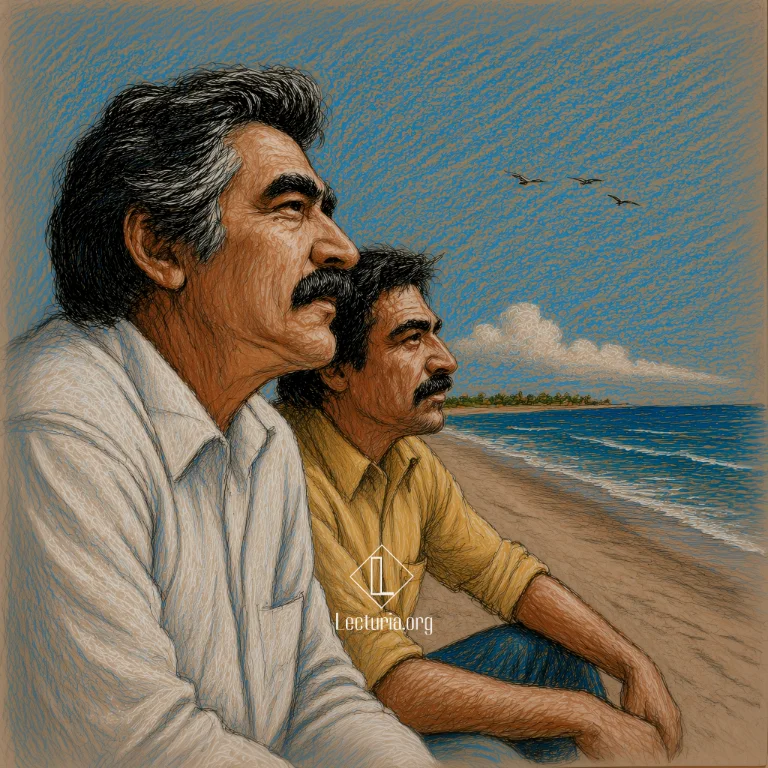
Ernesto, a painter, and his friend, a writer who narrates the story, meet one summer in Lima and decide to make a long-shared project a reality. Weary of the bustle and sophistication of the great European cities, and certain that they have already wrung as much as they could from their lives there, they dream of a primitive and solitary refuge on the shores of the Peruvian sea, the landscape that marked their childhood. They frequently allude to what they call “the call of the desert.” The first foray takes them to Conchan, fifty kilometers south of Lima, where they immediately discover that the beach does not suit their purposes: it is too close to the capital, the sea is rough, and above all, it has ceased to be a solitary place. Cars in convoy and residents from neighboring shanty towns have turned that stretch into a popular beach. They find that the old southern resorts—Punta Negra, Punta Hermosa, San Bartolo, Pucusana—have also been engulfed by urban growth, and conclude that, to find the ideal spot, they will have to venture much farther away.
The following summer they travel to Ica, three hundred kilometers to the south, with a recommendation for a certain Doctor Tacora, a local lawyer who promises to guide them to Laguna Grande, a cove where he himself has an isolated house and is accustomed to retreating “to fish, read, and meditate.” Tacora shows up hours late, escorts them in his red Volkswagen to the turnoff, hands them the key to his house, and leaves them alone on the road under a blazing sun. In Ernesto’s old Ford pickup, the two friends cross a desert of confusing tracks that split and rejoin, guided by instinct and the fascination of the landscape. When they finally reach the sea, they discover that Laguna Grande is not the deserted beach they were promised: a score of wooden shacks, a hundred locals working on the lagoon, and a worm-eaten house as the only shelter. There, in a small grocery store, they encounter a dwarf who barely peers over the counter and an enormous Black man sleeping on the floor who, upon waking, watches them with distrust while fingering a sharp object in his pocket. The fishermen refuse to sell them their catch; a woman ends up forcing an overpriced sea bass on them; the gas canister is empty; and they do not know how to clean the fish. Defeated by the heat, melted sandwiches, and warm beer, they abandon the place. Ernesto, upon reaching the middle of the desert, discovers that his wallet, left in the glove compartment, has been stolen.
Back in Europe, far from giving up, the friends draw lessons from the “fiasco of Laguna Grande”: the beach must be absolutely deserted, but also reasonably accessible; they must reconsider the house itself, whose shape has been changing in their fantasies from a Miraflores-style bungalow to structures of concrete, adobe brick, or double-roofed cane. Two years later they set out on a third excursion, this time in a four-wheel-drive Land Rover, toward a beach south of Laguna Grande, in the former sandy expanse of the Ocucaje hacienda. They cross small ranches, half-buried palm trees, undulating dunes, a landscape of sandy pyramids shaped by the wind, and a military exercise zone. When they finally spot the sea, they find fishermen once again, settled in curious conical straw huts that can be moved according to the wind. Ernesto views them with an artist’s eye and wonders whether this might be the solution for his own dwelling. However, while rolling along the shore toward a distant rocky outcrop, a sharp blow under the truck bends the front axle. They go to ask the fishermen for help but encounter the same closed indifference they found at Laguna Grande; no outsider is welcome. By sheer manpower they manage to free the vehicle. The wind becomes a sandstorm—a paraca, “sand teeth”—and they return to Ica defeated once more.
The following excursion, already the next year, introduces a variation: the two friends, both married with children in Europe, decide to be accompanied by two young female friends, Carol and Judith. They manage to stay at the Pesca Perú vacation club near the Hotel Paracas, reserved for senior employees of the company. The first day passes between the pool and dishes prepared by the Japanese cook. In the evening, at the Hotel Paracas bar, they are approached by don Felipe Otárola, an old friend of Ernesto’s and a winemaker from Ica, who persuades them to visit his vineyard the following day. The girls refuse to go along, and the two men cross the tablazo alone to Ica, where Otárola takes them through the vineyard row by row, half-crouched under the sun, and sends them off with several pisco sours and, above all, with a ten-liter demijohn of his personal pisco: the botellón. Back at the club, the afternoon dissolves into cocktails and dips in the pool, while the cook reminds them—without anyone listening—that the ceviche is getting warm and the rice with chicken is getting cold. At dusk they realize two things: they have not eaten lunch and they have once again postponed the search for the deserted beach.
Even so, they load the botellón into the truck and head out into the sandy expanse at nightfall. Twenty kilometers in, at an unmarked fork, they uncork the pisco and drink straight from the neck. A secondary road takes them away from the sea and deeper into the desert. They get out on foot and, intoxicated by both the liquor and the nocturnal spell of the sand, begin to run and spread out from one another. The narrator is left alone with Judith beneath a starry vault that he associates with the astronomical knowledge of the ancient coastal peoples. When Ernesto and Carol’s shouts alert them, the four search for one another by calling out in the darkness, shortening their names to the final syllable—“to,” “it,” “ol,” “lio”—until they find each other again. Guided by the Southern Cross they return to the truck, and only when they start the engine do they realize they have forgotten the botellón in the desert, beside a yellow kilometer marker at kilometer 33.
The night also reshuffles the pairings, and Ernesto and Carol share a bungalow while the narrator and Judith share another. The next morning, as they prepare to leave, visitors arrive at the club: don Raúl Rojas Ruiz, a senior Pesca Perú executive, and his wife. To him—whom the four christen RRR—the narrator proposes, over lunch and between beers and piscos, a riddle to locate the lost botellón: a certain kilometer connected to the Catholic faith. RRR, an old pisco aficionado, pretends to go take a nap and then rushes off in his car to look for the botellón on his own. The four set out in the truck after him and, guessing he will start at kilometer 12, “the apostles’,” they arrive first at kilometer 33—the age of Christ—and recover their prize. They toast right there under the sun, with a pisco that tastes “like sacred fire,” and on the way back they pass RRR’s car heading precisely toward that marker. That evening at the club bar, RRR avoids them, visibly embarrassed, and they make not the slightest allusion to the hand they have won. The next day they must return to Lima: once again the deserted beach has slipped away, but at least they have the rescued botellón.
The fifth attempt takes Ernesto and the narrator, this time without the female friends, in search of their refuge on an island, seduced by the literary aura of becoming modern Robinsons. From the La Puntilla pier they manage, with a tip, to get a small tugboat to take them to the Chincha Islands, where guano is extracted only sporadically. After three hours of sailing they arrive at the right-hand island and are welcomed by Eleodoro Pauca, an Andean-featured guard from Huaraz, and by the pilot, don Pedro, who takes advantage of the trip to traffic in provisions and fish. The house, rectangular with a long corridor, dates from the nineteenth century and has the air of a British colonial factory: picturesque but uninhabitable for the dream they have been cultivating. While the owners of the house go out to fish in a small boat, the friends swim naked in the channel between the islands, until a herd of sea lions plunges into the water toward them and forces them out of the sea in a scrambling retreat. In the afternoon they eat ceviche and sole, and learn from the conversation between Eleodoro and don Pedro about the pilot’s covert dealings, but also about a greater threat: in a month or two, nearly a thousand laborers will arrive from Huaraz for the guano harvest, bringing traders, liquor, coca, and even women in their improvised stalls.
Ernesto and the narrator nonetheless climb the hill of the island and find, in the shape of a crescent, the ideal beach, though far from the pier. Ernesto already envisions a wide, airy bamboo and cane house on stilts, very different from the heavy factory of the caretaker. Tempted, they consider staying for a week. But then, from the neighboring island, the sea lions begin a collective roar that goes on for hours: an orchestration of battle cries, wails, screams, and moans that bounces off the rocky walls and leaves them terrified. When Eleodoro informs them that this “lasts for hours” and that one gets used to it, and when they remember the thousand laborers to come and the remoteness in case of any emergency, they choose to return with the pilot. It is dusk when they move away from the islands, still pursued by the roar of the sea lions, perhaps by now hallucinated.
Back in Paris, disheartened, they stop talking about the matter for a while. Ernesto moves to Milan and then to New York, and the correspondence between the two on the subject shrinks to allusions in postscripts and the occasional mailing of a sketch of a dreamed house in the shape of a half-dome, inspired by some spot in northern Canada. Three or four years later they coincide in Lima again. Older—Ernesto somewhat paunchy, the narrator thinner—but also more fed up than ever with the “old culture,” the call of the desert resurges. One evening, seated in a Miraflores café and watching the former seaside resort transformed into a dense urban sprawl that resembles the very metropolises they had been fleeing, they tell each other that there is still time. Until now they have only explored the south, but the Peruvian coast stretches nearly three thousand kilometers. They decide to head north now, stopping at every cove. When the narrator asks what they will do if they cannot find the desired beach, Ernesto replies, very seriously, that in that case the house will exist only in the imagination and, for that very reason, will be indestructible. Days later, they roll off toward the beaches of the north.
Literary Analysis of The Beach House, by Julio Ramón Ribeyro
“The Beach House” is one of Ribeyro’s late stories, included in the fourth volume of La palabra del mudo and written in Barranco in 1992, a few years before the author’s death. It belongs to that final stretch of his work in which the Peruvian narrator no longer conceals the autobiographical roots of his tales, and in which his characters increasingly resemble himself: writers or artists of advancing years, based in Europe, who look toward Peru with a mixture of longing and disenchantment. The story can be read on a first level as a comedy of travels, a series of frustrated expeditions told with humor; on a second level, as a meditation on the impossibility of the ideal refuge; and on a third, as a fable about the way in which dreams, by remaining unfulfilled, become more enduring than any real construction. Its symbolic structure rests on a simple figure: the house that is never built, surrounded by a desert that does exist, but that each time it is visited turns out to be inhabited by others.
Formally, the story belongs to a well-recognizable subgenre in Ribeyro: the memoir narrative transposed into fiction, related to the travel chronicle and to the tradition of the long short story or short novella. There is no single conflict concentrated in one scene, but rather an episodic succession of attempts ordered by accumulation. Each expedition functions as a small autonomous narrative unit, with its own landscape, secondary characters, and comic or bitter payoff, and all are articulated with one another as variations on a single theme. This serial structure, more characteristic of the travel narrative or the diary, coexists with devices from the traditional short story—the epigrammatic close, the final twist—and explains why the piece extends beyond the usual brevity of the genre without losing tension.
The two protagonists, Ernesto and the narrator, are characters fashioned from biographical ink. They have lived in Europe since they were young, are nearing fifty, have wives and children on the other side of the Atlantic, and are devoted to artistic occupations: Ernesto paints and apparently also works with plastics; the narrator writes. Their central motivation is a double movement: the rejection of the cosmopolitan city, which they find oversaturated and hollow, and the return to a childhood landscape of which they preserve an almost mythical memory. What they seek is not so much a beach as an image of themselves in which they believe they can be reconciled with the world. Hence both of them keep changing, throughout the story, their architectural fantasies—a Miraflores-style bungalow, a concrete house, adobe brick, cane on stilts, an oval Canadian dome—without any one of them ever being decided upon: the house is, from the very beginning, less a building than a form of their desire.
Around them orbits a gallery of secondary characters rendered in a few strokes but memorable: the unpunctual Doctor Tacora, who speaks pompously of “fishing, reading, and meditation”; the dwarf behind the counter and the giant Black man with a sharp instrument at Laguna Grande; the viticulturist Otárola, a fanatic of his vines, who imposes a stifling row-by-row tour; the senior executive RRR, a pisco aficionado and competitive spirit; the Andean caretaker Eleodoro Pauca and the smuggler pilot don Pedro. All of them are obstacles or distractions: they represent the concrete social reality of Peru—popular coves, agrarian reform, fishing bureaucracy, informal economies—that interposes itself again and again between the two dreamers and their imaginary refuge. Ribeyro portrays them without condescension or caricature, but also without idealizing them, and makes visible how the world the protagonists hoped to find pristine is, in reality, densely occupied.
The narrator is one of the pillars of the story’s effect. This is a first person in the plural—that “we” that alternates with “I” when the action requires it—at once Ernesto’s accomplice and slightly distanced from the impulsive, exclamatory, outburst-prone Ernesto. He is a mature, cultured narrator who allows himself references to Rousseau, to Robinson Crusoe, to Bacchus and Silenus, and who regards his characters, including his own younger self, with an affectionate irony. At one especially revealing moment, he interrupts the story to announce outright that the third excursion will also be a failure, “so as to go against the rules that establish the creation of suspense in a narrative.” That metanarrative wink places the narrator outside the time of the action, like someone who organizes his memories with the freedom of one who already knows how everything turned out.
The setting—the Peruvian coast—functions almost as a third protagonist. Ribeyro describes it with geographical precision: Conchan, Punta Negra, Pucusana, Laguna Grande, Ocucaje, Paracas, the Chincha Islands. But more than picturesque color, there is a genuine treatise on the modes of the Peruvian desert and sea: the tracks that fork in the sand, the pyramids shaped by the wind, the paraca that arrives like bursts of buckshot, the rough sea of Conchan, the lagoon enclosed between headlands, the cloudless starry vault of the sand flats. It is this landscape that gives meaning to the expression the friends turn into a motto, “the call of the desert”: an ambiguous force made at once of aesthetic seduction, childhood nostalgia, and the promise of a void where one can simply be oneself.
Several themes interweave in the story and give it depth. The first is the impossible return: going back to the homeland after decades in Europe means encountering a Peru that has changed—resorts turned into sprawling cities, beaches overrun by the motorized middle class, shanty towns descending the dunes—so that the mythical landscape of childhood exists only as memory. The second is class estrangement: the protagonists are outsiders in their own country, “artists of rather modest means” yet equally foreign to the fishermen, locals, and guano workers they stumble upon, and that foreignness manifests itself above all in the indifference with which the natives receive them, “an ancestral rejection of outsiders.” The third is the theme of time and aging: the friends seek their refuge already in their fifties, with bodies that now and then remind them they are no longer the young men who swam between Chorrillos and Miraflores. And a fourth, more intimate theme is the relationship between desire and fulfillment: the dream loses force when it is concretized, and so the protagonists seem to need the search more than the discovery.
The ultimate meaning of the story is condensed in the phrase with which Ernesto responds, near the end, when his friend asks what they will do if they cannot find the deserted beach: if they cannot find it, the house will exist only in the imagination and, for that very reason, will be indestructible. This conclusion retroactively reorders the entire story. The five failures are not, then, an accumulated defeat, but the condition that keeps the fantasy alive. The purpose of the story is not to narrate how two friends obtain or lose a house, but to show how a shared project can become, over the years, the framework that sustains a friendship and a way of inhabiting the world. The house that is never built is more livable than any real house because it never deteriorates, never becomes a neighborhood, never fills with the sounds of strangers.
Ribeyro’s style combines classical elegance and colloquial naturalness. The descriptions of the desert and the starry sky deploy a cultivated vocabulary and a measured syntax, with broad enumerations that can almost be read aloud: astronomers, diviners, potters, weavers, farmers, fishermen, builders of roads, temples, and cities, all educated in “the school of the cosmos.” Against this contemplative register, Ernesto’s interjections—“¡Coño!” “¡Las huevas!” “¡Viva la civilización!”—break in with a contemporary Peruvian vernacular and jolt the narrator and reader out of lyricism and into comedy. This oscillation between the high and the low, sustained with great control, is a distinctive mark of the mature Ribeyro.
The overall tone is at once ironic and melancholic, with a humor that never quite mocks the characters because the narrator is inside them. The rhythm of the prose is serene, slightly unhurried: Ribeyro allows himself digressions on the protagonists’ married lives, on the consequences of the agrarian reform in the Ica vineyards, on the sociology of Conchan, and the story advances in waves rather than leaps. Narrative tension does not come from intrigue—the reader soon senses that no expedition will succeed—but from the way each episode deepens the relationship between the two friends and the meaning of their enterprise.
Among the literary techniques worth highlighting is the deliberate use of parallelism: each expedition reproduces elements from the previous ones—the stifling heat, the indifference of the locals, the breakdown, the return at dusk—so that the reader recognizes the pattern and enjoys it, as one enjoys variations on the same musical theme. The narrator himself marks this by calling the second failure “so similar to the first as to seem a new version with a few variants.” Another central technique is the symbolic use of objects: the botellón of pisco, which appears at the midpoint of the story, becomes laden with meaning—trophy, obstacle, pretext, emblem of the life that distracts them from their search—and for a time displaces the deserted beach as the true engine of the action. Also noteworthy are the nocturnal scenes, such as getting lost in the starlit desert, which introduce an almost visionary register without abandoning verisimilitude. And it is worth pointing out, finally, the intelligence with which Ribeyro closes: the final scene shows not a resolution but a new beginning, that of the expedition northward, leaving the reader with the feeling that the two friends will go on searching forever, and that the story, like the house, will only fully belong to them if it never quite comes to an end.