Poul Anderson: Quixote and the Windmill

Poul Anderson: Quixote and the Windmill

“Quixote and the Windmill” is a short story by Poul Anderson, published in November 1950 in Astounding Science Fiction. In the future, Earth has achieved full automation: production is almost entirely automatic, machines perform all routine tasks, and human beings live surrounded by comfort, leisure, and abundance. The workday is minimal, basic needs are met, and people can devote their time to creativity and recreation. In this world of technological utopia, two men drink in a bar as they drown their frustration over a world that seems no longer to need them.

Jack London: Love Of Life

Jack London: Love Of Life

In “Love of Life,” Jack London recounts the harrowing journey of two men lost in the Canadian wilderness. Weak and starving, they struggle to survive as an unforgiving nature subjects them to relentless trials. Faced with dwindling food supplies and mounting injuries, their bond fractures and one abandons the other. From that moment on, the narrative follows the solitary odyssey of the deserted man, who—stripped of nearly everything—must find the strength and the means to keep going. The story explores the outer limits of human endurance and the tenacious fight for life amid overwhelming desolation.

Gabriel García Márquez: I Sell My Dreams

Gabriel García Márquez: I Sell My Dreams

“I Sell My Dreams” (Me alquilo para soñar) is a short story by Gabriel García Márquez, published in 1992 in the collection 12 cuentos peregrinos. It recounts the author’s own experiences with a mysterious woman he met in Vienna. A tragic event that took place in Havana serves García Márquez as the occasion to evoke this fascinating character, who possesses a very special gift: the ability to foresee the future through dreams. The story moves between the fantastic and the journalistic, and also includes a delightful anecdote involving Pablo Neruda.

Jorge Luis Borges: Funes, His Memory

Jorge Luis Borges: Funes, His Memory

“Funes, His Memory” (Funes el memorioso) is a short story by Jorge Luis Borges, first published in June 1942 in the newspaper La Nación, and later included in the book Ficciones (1944). It recounts the story of Ireneo Funes, a young man who, after an accident, acquires a prodigious memory: he can recall every detail of his life and surroundings with absolute precision. The narrator, an alter ego of Borges, reflects on the implications of this ability. Far from turning Funes into a sage, his perfect memory renders him incapable of abstraction or generalization, trapping him in a world of overwhelming details. Borges thus offers a profound meditation on the limits of knowledge and memory, suggesting that forgetting, to a certain extent, is necessary in order to think and to live.

Edgar Allan Poe: The Pit and the Pendulum

Edgar Allan Poe: The Pit and the Pendulum

“The Pit and the Pendulum,” a short story by Edgar Allan Poe published in 1842, is a chilling tale that follows the anguish of a prisoner during the Spanish Inquisition. After being sentenced, the protagonist awakens in a dark and sinister cell, unaware of the fate that awaits him. In this claustrophobic place, he discovers that the punishment he has been assigned was conceived by a twisted and sadistic mind. Faced with various mechanisms of torture, the prisoner is subjected to extreme physical and psychological torment, where terror and despair become his only companions as he struggles to survive in this earthly hell.

Robert W. Chambers: The Yellow Sign

Robert W. Chambers - El signo amarillo

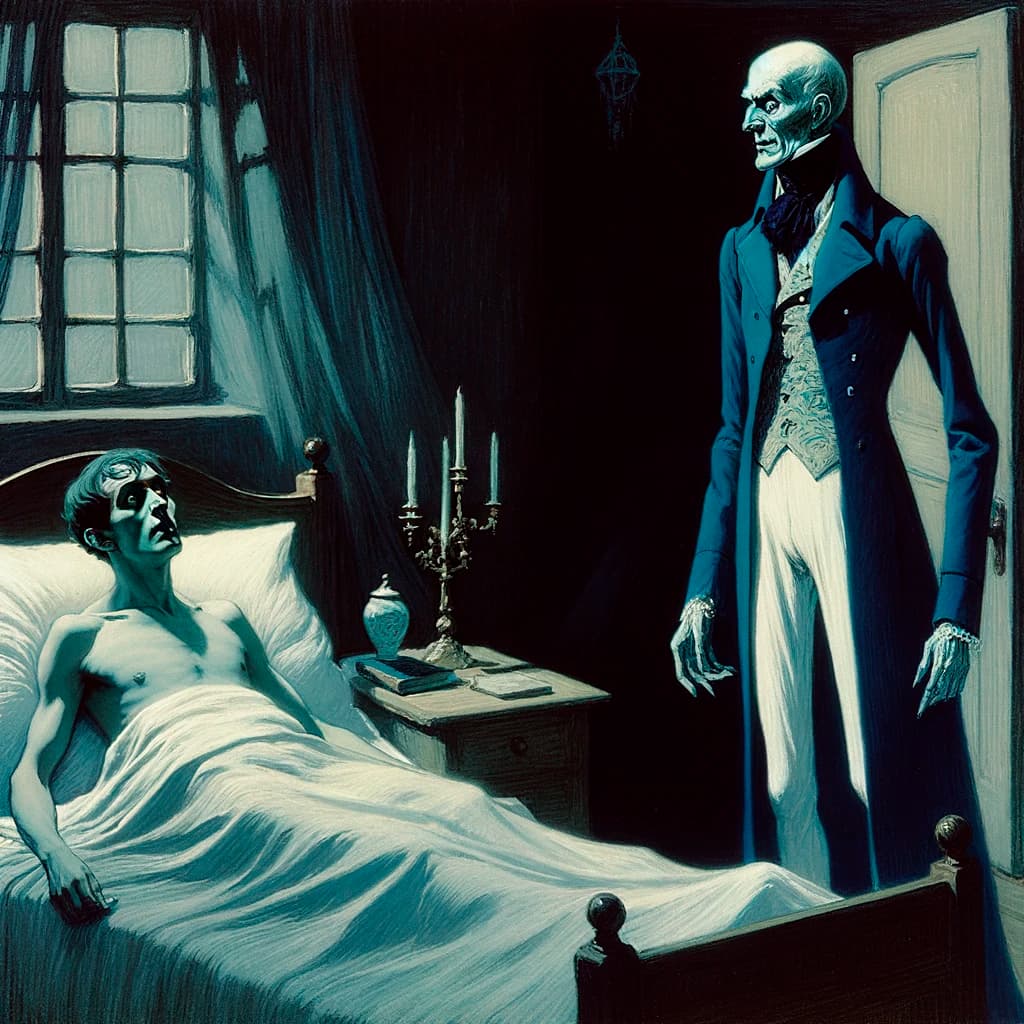
“The Yellow Sign” is a short story by Robert W. Chambers, published in 1895 as part of the collection The King in Yellow. While painting a portrait, an artist is disturbed by the presence of a mysterious man in the courtyard of the neighboring church. The man’s face—pale, swollen, and repulsive—makes a strong impression on him, which seems to contaminate even his work. Meanwhile, his model, Tessie, tells him about a recurring dream in which a mysterious coachman transports a coffin in a gloomy hearse. The girl is deeply shocked when she discovers that the man from the church is the same man who appears in her dreams.